Economists Sanford Grossman and Oliver Hart posited that ownership is not merely a formality but determines who has the final authority to make unspecified decisions in any relationship that creates real value. This concept is relevant to Linda Mwananchi, a movement with a recognisable brand, crowds, and media attention but no settled institutional form. Its leadership hierarchy remains unclear, while several principal figures remain members of other parties.
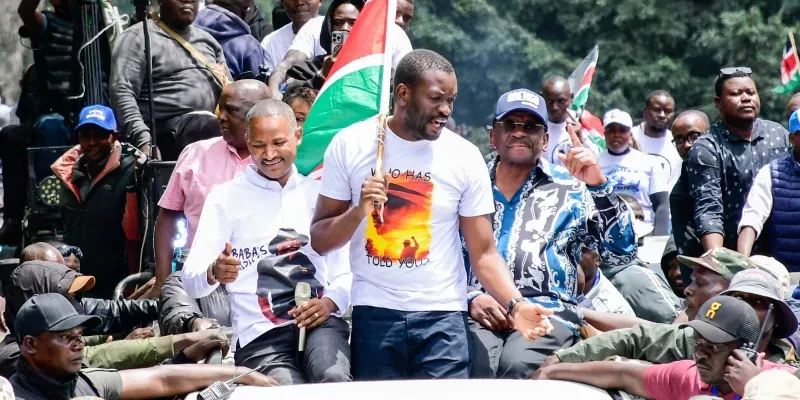
Linda Mwananchi's division of labour between Sifuna and Babu is effectively a contract, with Sifuna taking the presidency and Babu taking Nairobi governorship, and each campaigns for the other’s ticket. However, this contract is silent on who owns the movement's actual capital once it has been built. The events surrounding last week’s Jacaranda rally matter as Sifuna and Babu operate on overlapping political territory, drawing energy from similar urban constituencies.
Babu announced that he would attend fewer rallies and concentrate on his Nairobi gubernatorial campaign, also disclosing that he has his own political party. This reveals the structural tension inside Linda Mwananchi, with Babu's advantage being his command and mobilisation of urban street-level politics. His gubernatorial ambition gives him a clearer near-term electoral market, requiring ward agents, candidates, polling networks, money, and alliances.
By concentrating on Nairobi, Babu may not be retreating from Linda Mwananchi but accumulating the political assets that give him greater bargaining power within it. His separate party lets Babu negotiate nominations, coalitions, and resources without depending on another person’s goodwill. He can support Sifuna while retaining the capacity to move independently if Linda Mwananchi leaves him exposed.
The difficulty is that each man’s success can alter the balance between them. If Sifuna becomes firmly established as the presidential candidate, Linda Mwananchi’s Nairobi machinery may increasingly be expected to serve his national campaign. Babu would then risk supplying crowds, local networks, and political theatre while receiving uncertain control over the gubernatorial ticket and city campaign.
Babu’s Nairobi machine is his own version of Fisher Body's dies, an asset built for a specific purpose, controlled by one party, and worth considerably more to Sifuna's national campaign than it costs Babu to maintain independently. However, a national operation and a local one are not the same asset, with Sifuna requiring breadth across several counties, while Babu requires depth in one.
Seen from this perspective, breadth wins arguments about who should lead a movement, while depth decides who actually can, once the movement stops rallying and starts organizing a ballot. A man building his own political outfit for a takeover five years out, which is what Babu has openly stated, has little reason to fold its capital into a joint venture he does not control.
Key points
- The question of who controls Linda Mwananchi's residual rights of control remains unanswered.
- Babu Owino's separate party lets him negotiate nominations, coalitions, and resources without depending on another person’s goodwill.
- The battle for residual control within Linda Mwananchi will determine the movement's future.