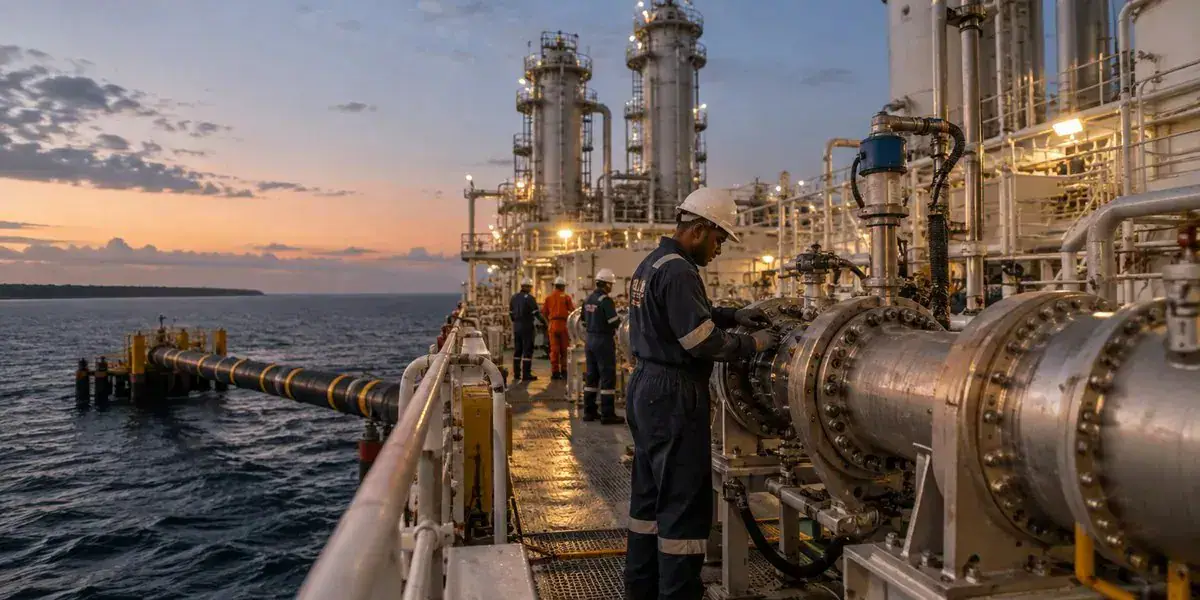
Mozambique's state hydrocarbon company, Empresa Nacional de Hidrocarbonetos (ENH), has secured binding technical support agreements with Sasol and ROMPCO for the Inhassoro floating LNG terminal. These agreements were concluded on the sidelines of the Africa Gas & LNG Summit in Maputo. The Inhassoro project aims to channel liquefied natural gas from the Rovuma Basin megaprojects in Cabo Delgado province into the existing regional pipeline network. This development is crucial for the country's and region's gas distribution and usage.
Sasol, the principal operator of the Pande and Temane fields, will provide advisory support across the feasibility study, Environmental and Social Impact Assessment (ESIA), and Front-End Engineering Design (FEED). This support will align the terminal's technical specifications with actual market offtake requirements. ENH's Director of New Business, Rijcard Manuel, emphasized the importance of this alignment. Sasol is one of the region's largest potential gas buyers and has been operating in the area for over 20 years.
ROMPCO, which operates the 865-kilometre cross-border gas pipeline connecting Temane to Secunda in South Africa, will make its technical and operational knowledge available to plan the physical interconnection between the future floating platform and the existing conduit. This agreement builds on over two decades of cooperation between ROMPCO and ENH. The pipeline is a public-private partnership, with ENH holding 40% through its subsidiary Companhia Moçambicana do Gasoduto (CMG), South African state entity iGas holding 40%, and Sasol holding 20%.
The urgency of the Inhassoro floating LNG terminal project is underscored by the projected decline in extraction at Pande and Temane. Sasol projects that extraction at these fields will end in 2030, although the company may invest to extend activity to 2031. The production licence runs until 2034. Without a replacement source, southern Mozambique and South Africa's industrial corridor face a structural supply gap. The Inhassoro terminal is expected to fill this gap and provide a new source of gas for the region.
The Mozambican government awarded ENH the concession to build and operate the Inhassoro FSRU and related reception and transport infrastructure at the Port of Beira in August. Financial structuring, development, and installation of the floating platform are the responsibility of SLIGM, a dedicated project company established in April through a shareholders and joint development agreement between ENH and three other state entities.
SLIGM, which comprises ENH, Electricidade de Moçambique (EDM), Portos e Caminhos de Ferro de Moçambique (CFM), and Hidroelétrica de Cahora Bassa (HCB), will oversee the development and installation of the floating platform. The Inhassoro floating LNG terminal concept positions Inhassoro as a reinjection hub that transforms Rovuma Basin LNG back into pipeline-ready gas. This project is expected to play a critical role in Mozambique's and the region's energy landscape.
The agreements with Sasol and ROMPCO mark a significant milestone in the development of the Inhassoro floating LNG terminal. According to Rudêncio Morais, chairman of ENH's board of directors, this infrastructure is crucial for the distribution and use of gas in the country and the region. Mlandzeni Boyce, ROMPCO's executive director, cited the long-standing cooperation between ROMPCO and ENH as a foundation for the new work. The project's progress will be closely watched by industry stakeholders and the Mozambican government.
Key points
- The Inhassoro floating LNG terminal project has secured technical support from Sasol and ROMPCO, advancing its development.
- The project aims to channel liquefied natural gas from the Rovuma Basin megaprojects into the existing regional pipeline network.
- The terminal is expected to fill a structural supply gap in southern Mozambique and South Africa's industrial corridor.
Reporting sources
- Mozambique floating LNG terminal wins Sasol and ROMPCO backing · FurtherAfrica