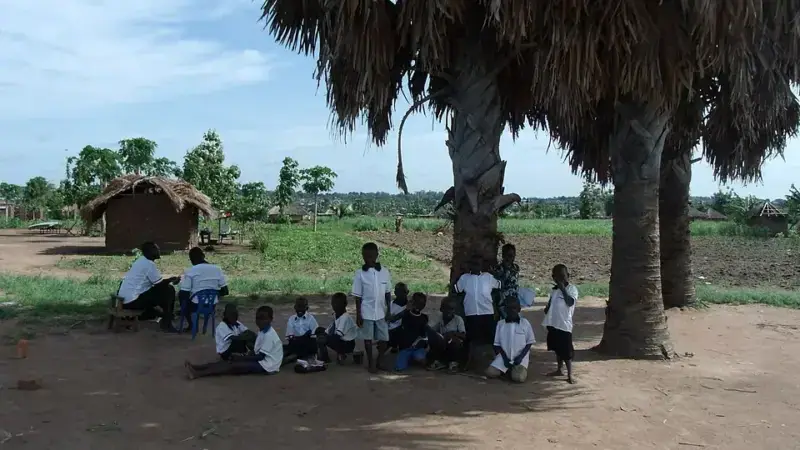
In Mozambique, thousands of students still learn in outdoor classrooms under trees, in improvised yards, or inside fragile structures that offer little protection from the elements. This is not a pedagogical choice, but rather a result of structural deficiencies, including a lack of infrastructure, materials, and an estimated 12,000 teacher deficit in 2025. The situation worsens during the rainy season, which runs from November to March, disrupting classes and hindering teaching continuity.
The Mozambican Minister of Education, Samaria Tovela, has been evaluating schedule adjustments due to frequent class interruptions during the rainy season and concentration challenges during periods of intense heat. Without proper blackboards or textbooks, and often with a single teacher responsible for several classes, the learning process becomes irregular and deeply unequal. One million students learn to read and write on the ground, highlighting a central problem: learning depends on minimum standards that are not yet guaranteed in Mozambique.
The introduction of artificial intelligence (AI) in Mozambique's education system is paradoxical, given the country's struggle to provide basic educational infrastructure. However, AI could potentially help bridge educational inequality. A major obstacle to introducing AI in rural African contexts is the lack of connectivity, with about 73 percent of Mozambique's population lacking internet access, according to 2024 data from the Ministry of Transport and Communications.
Regional inequalities limit the potential of solutions like distance learning or digital learning platforms, despite some progress in recent years. Another critical challenge is the linguistic and cultural dimension, with over 2,000 languages spoken in Africa, but only around 49 represented on digital platforms like Google's translation service. Integrating Mozambique's Indigenous languages, such as Emakhuwa, Xichangana, or Elomwe, into digital educational tools could increase students' comprehension and engagement.
Implementing solutions that integrate Indigenous languages raises practical questions in contexts where access to technology is limited. The majority of the Mozambican population speaks a Bantu language, making it essential to consider language and culture when developing educational tools. The role of the state is crucial in addressing these challenges and ensuring that education is accessible and equitable for all.
In rural districts of provinces like Cabo Delgado, Nampula, and Zambézia, classes under trees are common. The learning process is irregular and unequal, with students facing significant challenges, including lack of infrastructure, materials, and qualified teachers. The situation highlights the need for innovative solutions that can address these challenges and provide quality education to all students.
As Mozambique continues to navigate the complexities of education in the era of AI, it is essential to prioritize the development of infrastructure, materials, and teacher training. By addressing these challenges and considering the linguistic and cultural dimensions of education, Mozambique can work towards providing equitable and quality education for all its students, and AI can potentially play a role in bridging the educational inequality gap.
Key points
- Lack of infrastructure and materials hinders education in Mozambique
- Limited connectivity and language barriers challenge AI integration in education
- Prioritizing infrastructure, materials, and teacher training is crucial for equitable education
Reporting sources
- Learning under trees in the era of AI: The paradox of education in Mozambique · Global Voices Africa