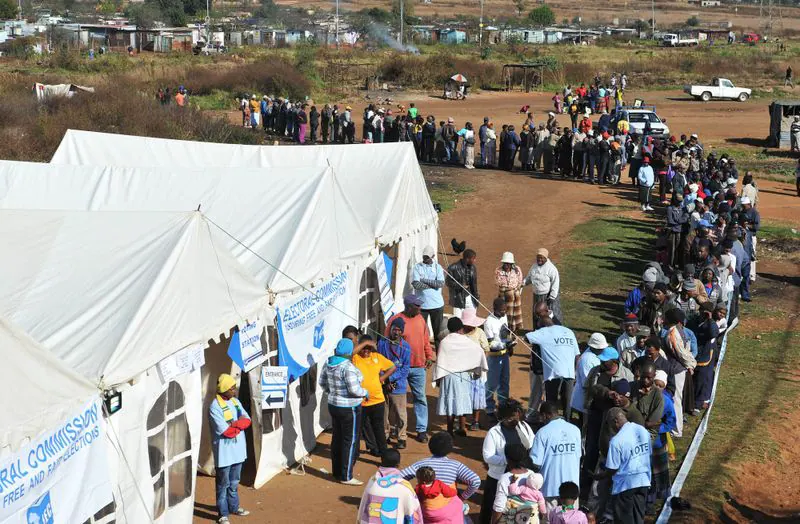
As the 4 November local government elections approach, South Africa may witness a significant turnout of non-voters, with data indicating that most eligible voters are choosing to opt out. The Electoral Commission of South Africa (IEC) recently announced that over 29 million people have registered to vote, a figure higher than the 26.8 million who registered before the 2024 elections. However, this represents only an estimated 63.7% of the eligible voter population.
Voter participation in South Africa has been steadily declining, from a high of 89.3% in 1999 to an all-time low of 58.6% in 2024. Professor Bruce Bartlett, an associate professor at Stellenbosch University, calculated that in the 2024 elections, only about 42% of the entire population turned up to the polls. When compared to international peers, including Brazil, France, India, the US, and the UK, South Africa's voter turnout as a percentage of its voting-eligible population was found to be at the bottom.
Youth disengagement is a significant driving factor behind the low voter turnout. IEC data estimated that in 2024, just 27% of the population aged 18 to 19 and 49% of those aged 20 to 29 were registered to vote, compared with about 80% or more among those aged 40 and older. Young people aged 16-29 account for 26% of registered voters, with data indicating that frustration and distrust in the current political system are prevalent among this age group.
Polling data from market research company Ipsos found that 47% of respondents felt no political party represented their views, and 38% had no interest in politics or elections. Forty percent of youth aged 18-34 said they did not trust the IEC. Mari Harris, Ipsos South Africa director and political analyst, noted that many people feel that voting makes no difference and that politicians only promise things and deliver nothing.
The dominance of the African National Congress (ANC) may also contribute to voter dissatisfaction. Dr Naledi Modise, a lecturer at North West University, found that one-party dominance had weakened accountability and contributed to voter dissatisfaction. The declining voter turnout could reflect a growing distrust in the country's democratic institutions.
Research reflects a growing dissatisfaction with democracy, with a July 2026 study by the Human Sciences Research Council finding that the share of young people who believed voting made a difference had sharply declined. Mbali Ntuli, founder and CEO of Ground Work Collective, attributes the decline in voter participation to a lack of civic education and growing frustration with record-high unemployment, lack of service delivery, and a stagnant economy.
However, the disengagement in voting does not mean a disengagement in politics, as many are turning to alternative ways of engagement, such as volunteering or being part of ward committees. Ntuli noted that South Africans across the board are having a decline in their confidence in democracy as a concept, and that people are looking for alternative ways to make a difference in their country.
Key points
- Most eligible South African voters are opting out of voting in the 2026 local elections.
- Youth disengagement and distrust in the current political system are significant driving factors behind the low voter turnout.
- The decline in voter participation could reflect a growing distrust in the country's democratic institutions.