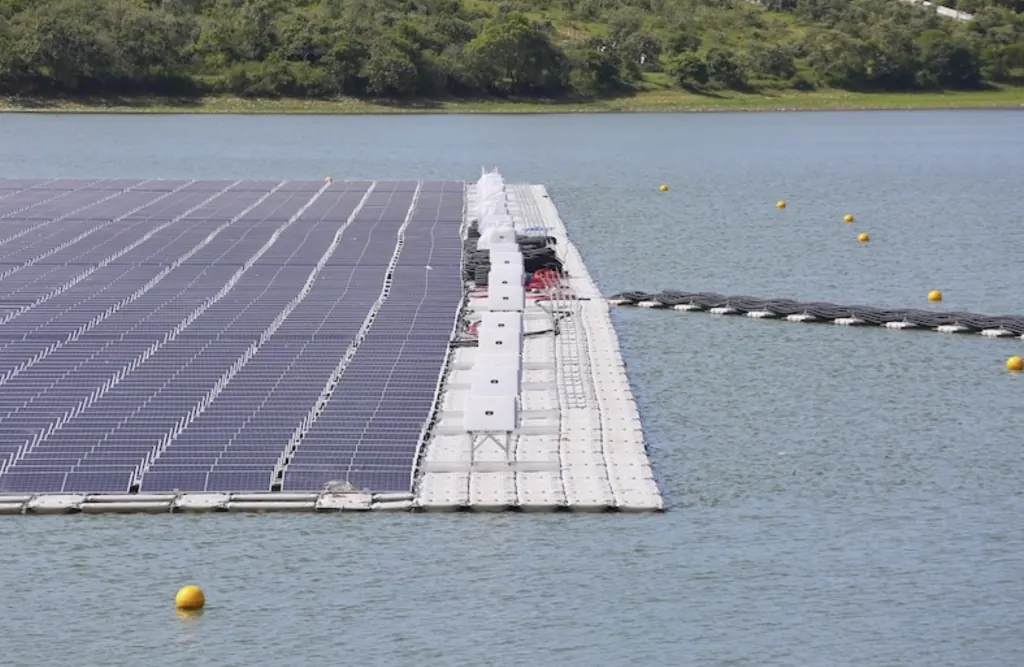
Morocco's Agency for the Sebou Water Basin is set to launch a feasibility study for the installation of floating solar plants on 12 dams in the basin. The project aims to combine water conservation and renewable energy production by utilizing water surfaces to reduce evaporation and generate electricity. The study will cover dams in the regions of Kenitra, Khemisset, Ouezzane, Moulay Yacoub, Sefrou, Taza, and Tounate.
The 12 dams included in the study are located in various regions and include the Al-Man'a dam on the Sebou River, Al-Qansara, Oulja Sultan, Al-Wahda, Sidi Al-Shahid, Al-Alal Fassi, Madaz, Bab Al-Wata, Idris I, Bouhda, Al-Sahla, and Asfalou. The project aims to reduce water loss due to evaporation, which can be lowered by 30-70% through partial coverage of water surfaces with floating solar panels.
The use of floating solar technology allows for the production of clean electricity without the need for additional land use, while also benefiting from the natural cooling provided by the water environment to improve the efficiency of solar panels. The study's first phase will involve collecting and analyzing data on the dams to determine the most suitable locations for the floating solar plants.
The second phase of the study will focus on evaluating the technical, energetic, economic, and environmental feasibility of various implementation scenarios, as well as studying the regulatory, property-related, and institutional aspects. The study will also analyze possible implementation models, including public-private partnerships, concession contracts, and projects led by independent producers.
Based on the evaluation results, priority sites will be selected, and initial designs for the proposed projects will be prepared, along with determining the economic models and financing mechanisms. A short-term, medium-term, and long-term implementation program will be developed, accompanied by an investment and development roadmap.
The project is expected to provide multiple benefits, including reduced water loss, increased renewable energy production, and job creation. The Sebou Water Basin Agency's initiative aligns with Morocco's efforts to increase its renewable energy capacity and reduce its carbon footprint.
The study is set to be completed soon, and the project's implementation is expected to begin in the near future. The Moroccan government has been actively promoting the development of renewable energy sources, including solar and wind power, as part of its efforts to reduce the country's dependence on fossil fuels and mitigate climate change.
Key points
- The project aims to reduce water loss due to evaporation by 30-70% through the use of floating solar panels on 12 dams in the Sebou basin.
- The study will evaluate the technical, energetic, economic, and environmental feasibility of various implementation scenarios for the floating solar plants.
- The project is expected to provide multiple benefits, including reduced water loss, increased renewable energy production, and job creation.