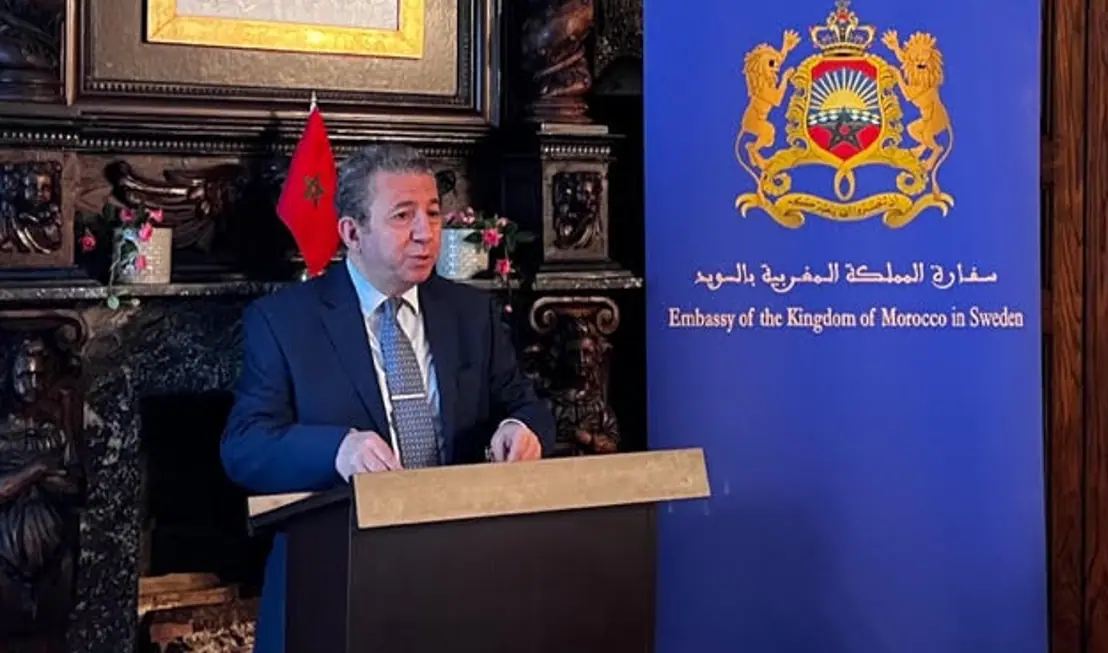
Moroccan Ambassador to Sweden Karim Medrek has stated that Morocco will continue its foreign policy based on constancy of principles, pragmatism, and diversification of partnerships. Speaking at a conference in Stockholm, Medrek outlined the key foundations of Morocco's foreign policy under the leadership of King Mohammed VI. The policy aims to balance fidelity to principles, diplomatic realism, and openness to the world. Medrek emphasized that Morocco's diplomacy focuses on its immediate neighborhood, African, Arab-Islamic, and Euro-Mediterranean spaces, as well as relations with major powers and international partners.
Medrek highlighted that defending Morocco's territorial integrity remains a central priority of the country's diplomatic efforts. He recalled the Moroccan autonomy initiative, presented as a serious and credible basis for a definitive political solution to the regional dispute over the Sahara. The ambassador also noted the recent sequence of events at the UN Security Council and the end of the MINURSO mandate. Morocco's diplomacy has evolved to prioritize economic diplomacy, aiming to enhance the country's attractiveness, encourage investments, and consolidate its strategic position linking Africa, Europe, and the Middle East.
The Moroccan ambassador emphasized the country's commitment to promoting regional integration, South-South cooperation, and shared development in Africa. He cited several projects, including the Nigeria-Morocco Atlantic-African gas pipeline and the Royal Initiative to facilitate Sahel countries' access to the Atlantic Ocean. These projects reflect Morocco's ambition to contribute to concrete solutions to the continent's economic and infrastructure challenges. Medrek also highlighted Morocco's engagement in favor of peace, regional stability, and counter-terrorism efforts.
Medrek stressed the importance of negotiation, trust, and credibility as foundations for durable international relations. He called on young students to adopt dialogue, listening, and mutual understanding as essential principles for addressing the challenges of an evolving world. The conference was part of a series of exchanges with Swedish academic institutions, following a previous conference at Uppsala University. These initiatives aim to enhance understanding of Morocco's strategic orientations and promote direct dialogue with young Swedes on major international issues.
Medrek's statements reflect Morocco's commitment to a constructive multilateralism based on dialogue, respect for international law, and peaceful dispute resolution. The country's diplomacy has been focused on building partnerships and strengthening its position on the international stage. Morocco's foreign policy approach is guided by a commitment to its principles and a pragmatic approach to international relations.
The Moroccan ambassador's visit to Sweden and his interactions with students and academic institutions demonstrate the country's efforts to engage with international audiences and promote its foreign policy approach. The conference provided a platform for Medrek to share Morocco's perspectives on key international issues and to promote dialogue and understanding.
Morocco's foreign policy approach under King Mohammed VI has emphasized the importance of balancing principles and pragmatism. The country's diplomacy has evolved to prioritize economic diplomacy and to promote regional integration and cooperation. As Morocco continues to navigate the complexities of international relations, its commitment to dialogue, understanding, and cooperation will remain a key aspect of its foreign policy approach.
Key points
- Morocco's foreign policy approach prioritizes constancy of principles, pragmatism, and diversification of partnerships.
- The country's diplomacy focuses on its immediate neighborhood, African, Arab-Islamic, and Euro-Mediterranean spaces, as well as relations with major powers and international partners.
- Morocco's economic diplomacy aims to enhance the country's attractiveness, encourage investments, and consolidate its strategic position linking Africa, Europe, and the Middle East.