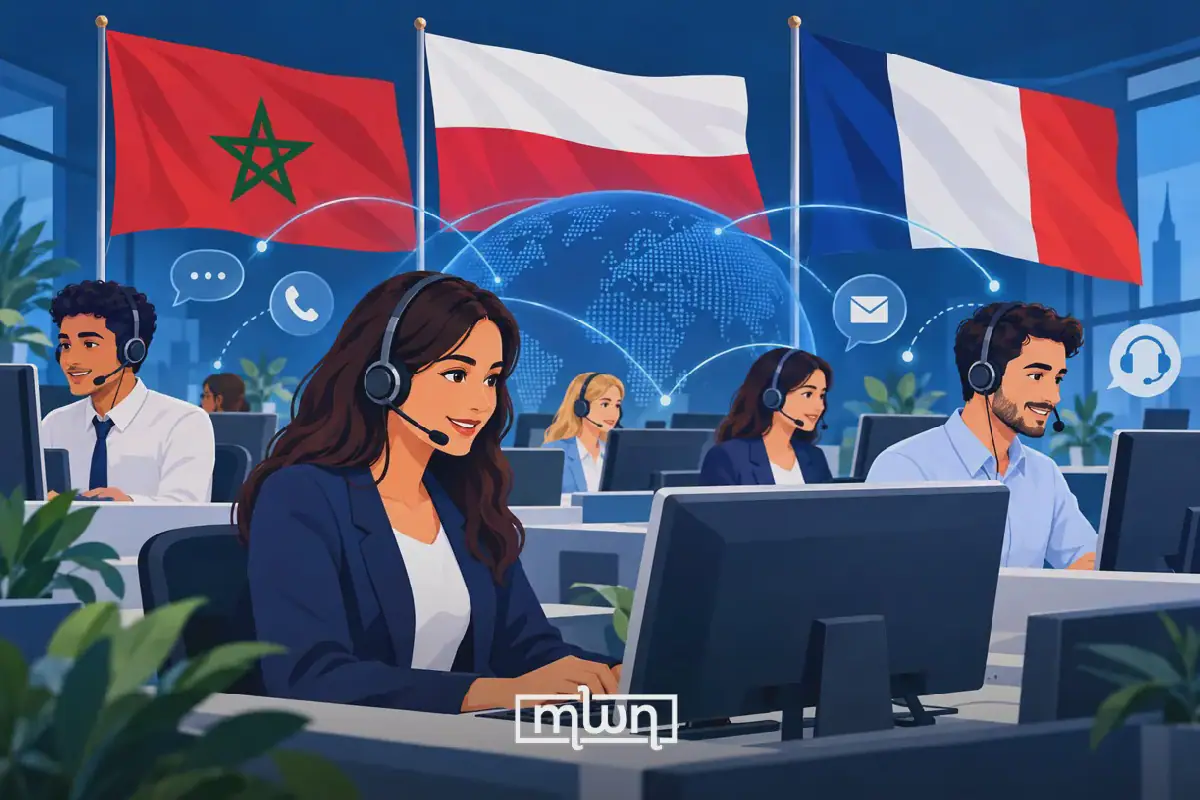
Morocco's digital economy is facing a significant challenge due to its heavy reliance on French clients. The country's call center industry, which employs around 150,000 people, was dealt a blow when France introduced new telemarketing restrictions in August. The law, which requires consumers' prior consent for sales calls, has resulted in an estimated 10,000 job losses, according to the UMT union federation. This has prompted the Moroccan government to seek new markets and diversify its digital economy.
The Moroccan government's Digital 2030 strategy aims to increase digital exports to MAD 40 billion and create 270,000 outsourcing jobs. However, the country's reliance on French clients has raised concerns about its vulnerability to changes in French regulations. In 2024, digital and offshoring services exports reached MAD 26.2 billion, with IT services accounting for 40.3% of that and customer relations for 37.4%. The government is now looking to Central Europe, particularly Poland, as a potential partner to help diversify its digital economy.
Poland has a well-established outsourcing sector, with foreign-owned business service centers employing around 150,000 people in 2015. Over the past decade, the sector has grown significantly, accounting for close to half a million jobs and 6.1% of GDP. Polish technology companies are now beginning to look at Morocco as a potential partner. The two countries have a similar population size, and Poland's experience in building a diversified outsourcing sector could provide a valuable model for Morocco.
One of the key advantages of Poland as a partner is its experience in working with multiple clients and languages. In Poland, foreign-owned centers, led by American, British, and German companies, account for 84% of the sector's jobs, and almost half of all centers work in IT. The common working language is English, which could help Morocco tap into the global market. Additionally, Poland's consumer prices are relatively low, standing at 73% of the EU average.
While Poland may not be a direct replacement for France, it offers a more diversified and sustainable partnership. The Polish Investment and Trade Agency has an office in Casablanca, and several Polish firms have already established a presence in Morocco. In October 2025, Warsaw described Morocco's autonomy plan as "a serious, realistic, and pragmatic foundation for a lasting solution" to the Sahara dispute, highlighting the potential for cooperation between the two countries.
The groundwork for cooperation between Poland and Morocco already exists. Bilateral trade between the two countries reached $2.5 billion in 2025, up from €180 million in 2009. Polish companies such as Asseco, Profil Software, and INCAT have already shown interest in Morocco's fintech sector. Additionally, Polmlek, which bought the dairy company Jibal in 2022, employs around 1,500 people in Morocco.
As Morocco seeks to diversify its digital economy, it will need to find new partners and markets. Poland and Central Europe offer a promising opportunity for cooperation, with their experience in building diversified outsourcing sectors and their proximity to Morocco. With the right approach, Morocco may be able to reduce its dependence on French clients and create a more sustainable digital economy.
Key points
- Morocco's dependence on French clients has been exposed by new telemarketing restrictions in France.
- Poland and Central Europe offer a potential partnership for Morocco to diversify its digital economy.
- The two countries have a similar population size and a growing outsourcing sector, with experience in working with multiple clients and languages.