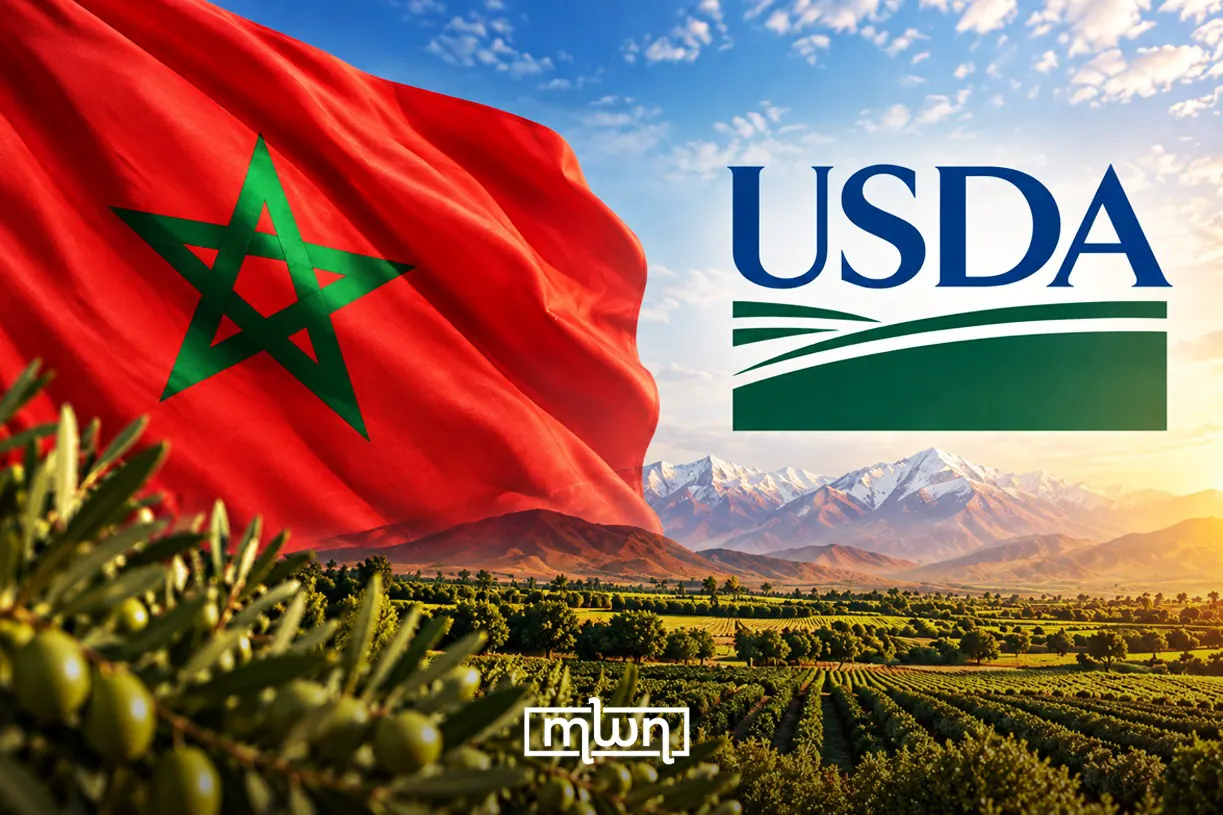
The United States Department of Agriculture (USDA) has selected Morocco as one of seven countries to receive a five-year award under its Food for Progress program. The grant, worth $33.1 million, aims to strengthen Morocco's food safety and livestock sectors. The project will be implemented by Counterpart International and is expected to benefit around 5,000 people. This award is part of a larger package of $825 million in international food assistance announced by the USDA on October 8.
The USDA's Food for Progress program will purchase 33,000 metric tons of US-grown soybean meal and wheat to support the project. This initiative is designed to modernize value chains and reinforce science- and rules-based trade. Morocco is one of seven countries, including Bangladesh, Bolivia, Ecuador, Sri Lanka, Thailand, and the Philippines, to benefit from this program. The grant is seen as a way to deepen economic ties between Morocco and the US, marking 250 years of friendship between the two countries.
The USDA's international food assistance package is administered across three programs: Food for Peace, McGovern-Dole Food for Education, and Food for Progress. The Food for Peace program will purchase 129,000 metric tons of US-grown commodities for emergency assistance in Ethiopia, Kenya, the Democratic Republic of Congo, and Haiti. The McGovern-Dole program will buy 62,150 metric tons for school meals in seven countries, reaching 6,415 schools and 1.2 million children.
Agricultural trade between Morocco and the US has reached new highs, with Morocco's farm imports from the US hitting $815.5 million in 2025, up 38% from $592 million in 2024. The main products imported by Morocco were corn, soybean products, and almonds. Morocco remains the only African country with a free-trade agreement with the US, in force since January 1, 2006. This agreement has widened market access and trade between the two countries.
In May, the USDA finalized a breakthrough that opened four new markets for American exports of bovine embryos, chicken hatching eggs, sheep, and goats. This development made the US the only country with official access for bovine embryos to Morocco. The USDA projected that this change would result in $3.75 million in total export value over five years. Research ties between Morocco and the US have also deepened, with Morocco's National Institute of Agricultural Research (INRA) receiving a North Dakota delegation in April.
The talks between INRA and the North Dakota delegation covered conservation agriculture, climate adaptation, and genetic improvement of durum wheat and barley. The Moroccan government aims to expand conservation agriculture to one million hectares by 2030. Commercial outreach has also been a key aspect of the bilateral relationship, with the USDA bringing nearly 50 American agribusinesses and 14 state agriculture departments to Casablanca in December 2024.
A Moroccan delegation returned the visit in California in June 2025, focusing on biotechnology, tree nuts, and sustainable farming. The partnership between Morocco and the US is set to deepen, with OCP North America and CHS announcing a proposed joint venture to build a phosphate fertilizer plant in Louisiana. The project carries an investment of up to $450 million and would be the first facility of its kind built in the US since 1984.
Key points
- Morocco receives $33.1 million USDA grant to enhance food safety and livestock sectors.
- Agricultural trade between Morocco and the US reaches new highs, with Morocco's farm imports from the US hitting $815.5 million in 2025.
- The partnership between Morocco and the US is set to deepen, with a proposed joint venture to build a phosphate fertilizer plant in Louisiana.