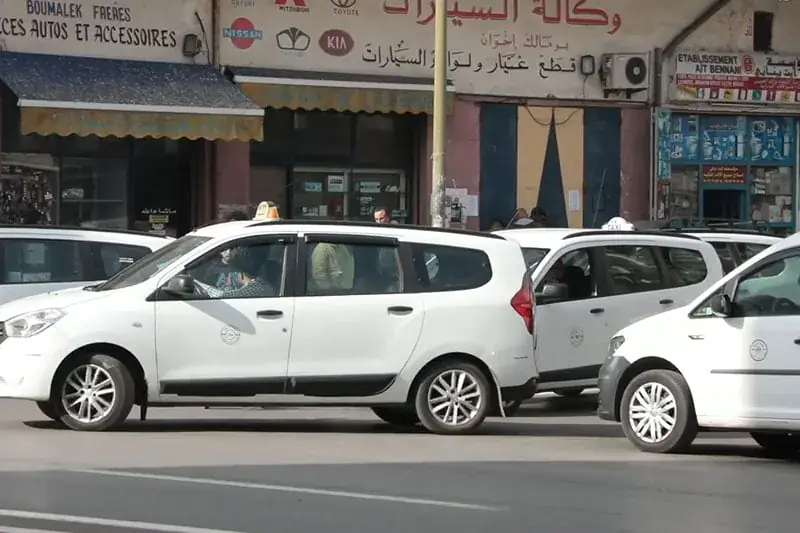
Residents of Skhirate, Morocco, face daily struggles with unregulated taxi services. Every morning, commuters stand on the roadside, waving at large taxis that speed by or stop to inquire about their destination before speeding off. Those who manage to flag down a taxi are not guaranteed a safe ride to their destination. The situation has become a daily ordeal for residents of Skhirate and surrounding areas, particularly along the Skhirate-Temara and Skhirate-Ain Atiq routes.
The main issue is the fragmentation of taxi routes. The original Skhirate-Temara route has been broken down into smaller, more profitable segments, such as Mimosa-Ain Al-Hayat and Ain Al-Hayat-Temara. This forces passengers to disembark and reboard multiple times, paying more than once and wasting time waiting. Passengers traveling to Ain Atiq or more distant areas often find themselves rejected, as drivers prefer shorter routes with guaranteed returns.
Investigations by Al-Massae at the Mimosa terminal have documented these grievances, with residents complaining that large taxis refuse to transport them to Temara and Ain Atiq. Instead, drivers treat the terminal as if it were their private property, rather than a public facility subject to the law. The situation worsened in early November when taxi drivers in Skhirate-Temara increased fares by two dirhams without prior notice.
The Moroccan government has announced a financial package of 400 million dirhams to support transport professionals, with large taxi operators receiving 1760 dirhams in subsidies. The goal is to maintain current fares without increases. However, in Skhirate, residents see the subsidy being allocated while fares continue to rise and routes are fragmented. This has led to concerns that the subsidy is not reaching its intended target.
One reason for this discrepancy is that the subsidy often benefits the license holder rather than the actual driver who operates the taxi daily and pays for fuel out of pocket. This has prompted unions to call for a review of the subsidy allocation mechanism to ensure it reaches the drivers who need it.
Residents are demanding urgent government intervention to regulate taxi services, including clear route definitions, fare monitoring, and penalties for non-compliance. They also call for a review of the subsidy system to ensure it benefits actual drivers. Furthermore, residents advocate for alternative public transportation options, such as regular buses connecting Skhirate to surrounding areas and Temara.
The people of Skhirate are not asking for the impossible; they want taxis that respect their designated routes, fair prices, and respectful treatment. As one resident noted, transportation is a right, not charity. If the situation persists, it may escalate from a transportation crisis to a crisis of trust between citizens and authorities.
Key points
- Moroccan residents demand government intervention to address unregulated taxi services and soaring fares.