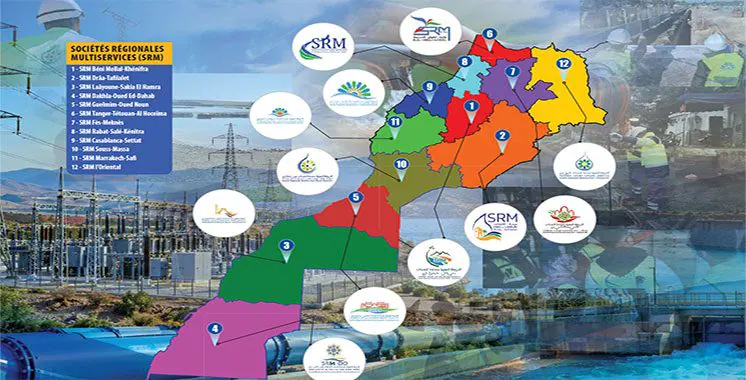
Morocco's ambitious reform to unify water, electricity, and sanitation services under regional multiservice societies (SRM) has encountered significant challenges in its early months. The SRM aims to streamline services across regions, replacing multiple operators with a single entity. The first SRM was launched in Casablanca-Settat on October 1, 2024, followed by others in Souss-Massa, the Oriental, and Marrakech-Safi. The reform seeks to improve efficiency and service delivery.
The implementation of SRM has been complex, involving the integration of various operators, including the National Office of Electricity and Water (ONEE), public agencies, and private concessionaires. In Casablanca-Settat, for example, the SRM had to merge five different entities, including Lydec, ONEE, and former public agencies. Over 4,700 employees were transferred to the new entity, which has faced difficulties in unifying systems, including billing and customer data.
One of the primary challenges faced by SRM has been billing and customer complaints about increased water and electricity bills. The Ministry of Interior attributed the issue to irregular meter readings by previous operators, which led to estimated consumption being billed. SRM, however, bills based on actual consumption, resulting in a catch-up effect that has led to higher bills for some customers. The ministry emphasized that tariffs have not changed, but the transition has caused confusion.
Another issue has been the transfer of payments and customer data from previous operators. In some cases, customers have been asked to pay bills they claim to have already settled with previous operators. This has raised concerns about data accuracy and transfer. The director general of Casablanca-Settat's SRM acknowledged that unifying information systems has been a significant challenge.
The SRM in Casablanca-Settat has faced particular difficulties, with several elected officials reporting problems with water supply, sanitation, and electricity. Some areas have experienced water outages lasting several days. The lack of communication with officials and customers has exacerbated the issues. The challenges highlight the complexities of integrating multiple operators and systems.
Despite the challenges, the Moroccan government remains committed to the SRM reform, which aims to improve service delivery and efficiency. The Ministry of Interior has acknowledged the difficulties but emphasized the need for patience and cooperation from all stakeholders. The government has encouraged customers to report any issues and has promised to address them promptly.
As the SRM reform continues to roll out across Morocco's 12 regions, it is clear that the process will require significant time, effort, and resources. The government will need to address the technical, financial, and communication challenges that have arisen. With a unified system, Morocco hopes to improve the delivery of essential services to its citizens.
Key points
- The implementation of SRM has faced challenges, including billing issues and customer data transfer problems.
- The Moroccan government remains committed to the SRM reform, aiming to improve service delivery and efficiency.
- The reform seeks to streamline services across regions, replacing multiple operators with a single entity.