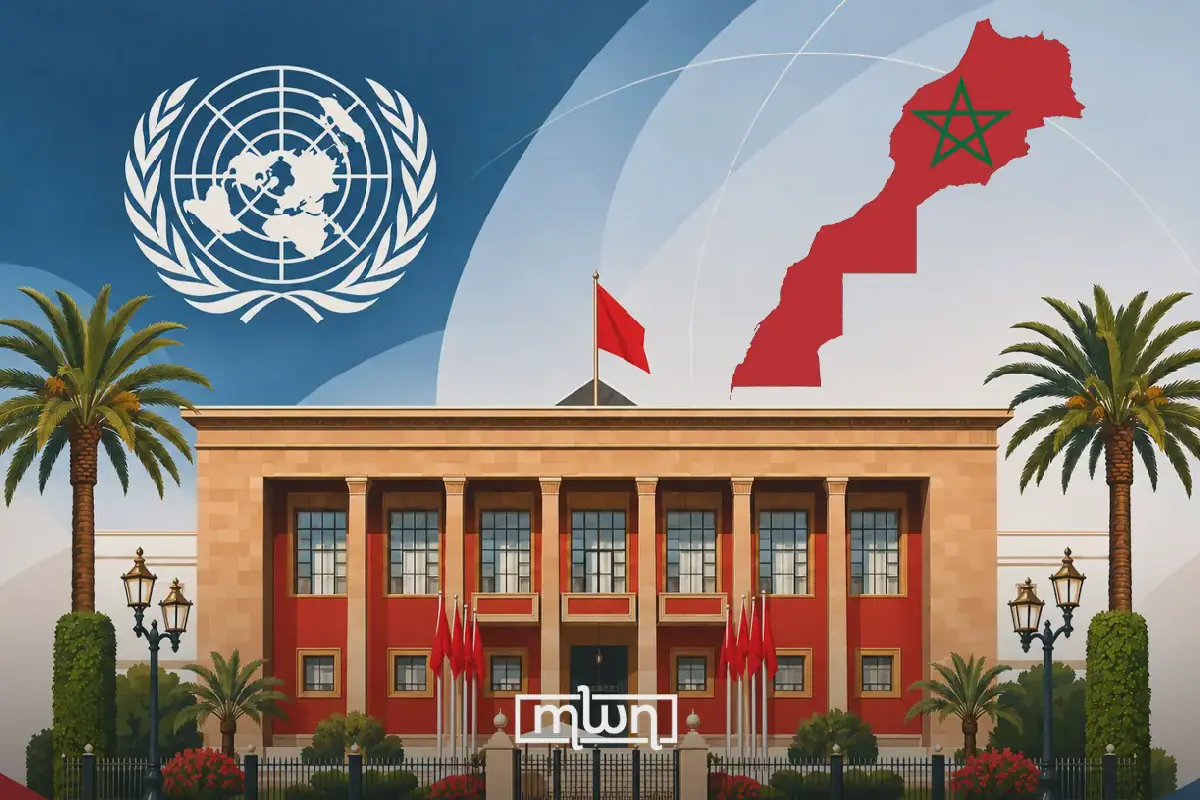
Morocco's parliament held a joint session to discuss the latest developments in the Western Sahara file, following the UN Security Council's decision not to renew the mandate of MINURSO, the peacekeeping mission that had operated in the territory since 1991. The session saw convergence across the political spectrum, with parliamentary groups supporting the communiqué issued by the Royal Cabinet on October 30. Each group framed the non-renewal as a decisive step toward closing the file at the United Nations.
The parliamentary groups tied the moment to the first anniversary of Unity Day, a holiday decreed by King Mohammed VI, and to Security Council Resolution 2797, which anchored the autonomy initiative as the sole basis for negotiations. They pointed to the support of more than two-thirds of UN members for that plan and repeated the royal formula that "Morocco is in its Sahara and the Sahara is in its Morocco." The groups also paid tribute to the Royal Armed Forces and the country's war dead.
The National Rally of Independents (RNI) placed sovereignty at the center of its intervention, stating that Morocco "negotiates for a solution, and does not negotiate over its sovereignty." The group described sovereignty as "a constant that does not change with changing circumstances, does not depend on a vote, and is not affected by a veto." The RNI called on those held in the Tindouf camps to return to their homeland.
The Constitutional Democratic Social group, represented by Chaoui Belaassal, backed the departure of MINURSO, arguing that it had been tolerated for 35 years to organize an impossible referendum and monitor a ceasefire it did not control. Morocco, in his words, "remains in its Sahara, and the Sahara in its Morocco, until God inherits the earth and all upon it." The Socialist groups framed the cause as "a matter of nation and people, a consensus not subject to outbidding or narrow calculations."
The Justice and Development Party (PJD) called Resolution 2797 "a major historic achievement and a victory for legitimacy and Moroccan right." The PJD tied the defense of sovereignty to "reuniting the sons and daughters of one nation and the single Saharan families" and to "ending the family and humanitarian suffering of our brothers in the Tindouf camps, and their return, honored and dignified." The party framed the outcome as "a solution with no victor and no vanquished, one that preserves the dignity of all parties."
The Authenticity and Modernity Party (PAM) called the non-renewal "a pivotal station in the path of our territorial unity cause" and pointed to development projects in the southern provinces, including the Dakhla Atlantic port and a faculty of medicine and pharmacy in Laayoune. The PAM committed to continued parliamentary diplomacy to widen "the circle of international support for the Moroccanness of the Sahara." Algeria's state news agency responded derisively to the session, branding it "the greatest farcical play in the political history of states."
The Left Alliance parliamentary group offered a cautionary reading, arguing that the Russian veto raises "deep questions about the responsibility of the international system and the mechanisms of decision-making within it." The group warned that "alliances are not eternal guarantees" and called for Morocco to build its national strategy "on the fluctuations of international alliances." The group invoked the late resistance fighter Mohamed Bensaid Ait Idder, who rooted the position that "the Moroccan people is not subject to a referendum on its own land."
Key points
- Morocco's parliament interprets the end of MINURSO's mandate as a step toward closing the Western Sahara file.
- Parliamentary groups across the spectrum backed the government's stance on the issue.
- The non-renewal of MINURSO's mandate has sparked varied reactions from Moroccan political parties.