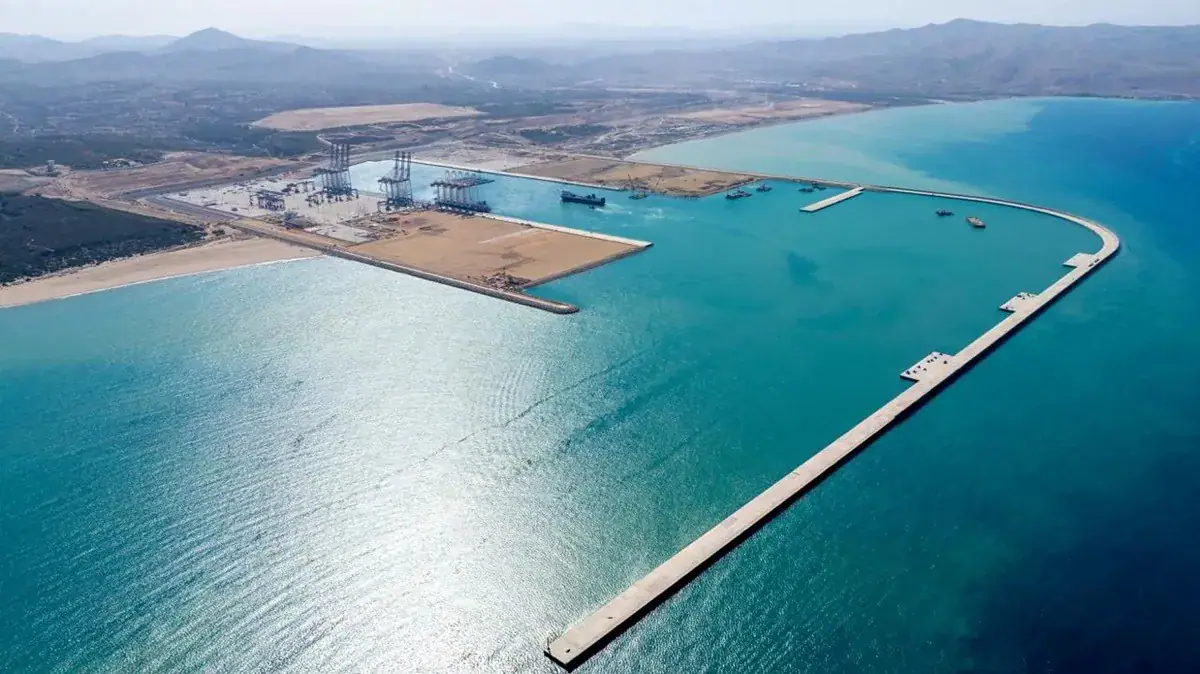
Morocco has officially launched operations at the first container terminal of Nador West Med, a major port complex on the country's northeastern Mediterranean coast. The East Container Terminal was inaugurated by Crown Prince Moulay El Hassan on October 31, acting on instructions from King Mohammed VI. The launch included the first commercial container unloading operation, marking the start of the port complex's gradual entry into service. The project aims to strengthen Morocco's position in Mediterranean trade and establish a new industrial and logistics hub in the Oriental region.
The Nador West Med project has attracted MAD 54 billion ($5.9 billion) in public and private investment. International media outlets have reported on the inauguration, highlighting different aspects of the project. Spain's El Español focused on the port's location near Melilla and its potential to compete with major Spanish ports. Switzerland-based Swissinfo detailed the scale of the project, including its investment, infrastructure, and involvement of MSC through its subsidiary Terminal Investment Limited.
The East Terminal required approximately MAD 5 billion in investment and features 1,520 meters of quay, a depth of 18 meters, and 70 hectares of storage yards. It is expected to reach an annual handling capacity of 3.5 million twenty-foot equivalent units (TEUs) by 2030. Marsa Maroc and Terminal Investment Limited (TIL), a subsidiary of Swiss-based shipping group MSC, will operate the terminal under a 25-year concession.
A second container terminal, the West Terminal, is expected to begin operations in April 2027. Operated by a partnership between Marsa Maroc and French shipping group CMA CGM, it will add 1.8 million TEUs in annual capacity, bringing the complex's combined container capacity to 5.3 million TEUs. The project builds on Morocco's experience with Tanger Med, one of the Mediterranean's major transshipment hubs.
Nador West Med extends beyond container shipping, with plans to develop an integrated industrial, logistics, and energy hub in Morocco's Oriental region. The complex includes a 700-hectare industrial and logistics platform expected to attract around MAD 12 billion in private investment. Its energy facilities will include a liquefied natural gas terminal with a planned annual handling capacity of five billion cubic meters and an oil terminal capable of handling up to 25 million tonnes.
The wider project is expected to create 14,000 direct jobs and 20,000 indirect jobs in the short term, according to official estimates. Authorities also plan to connect the port to the regional transport network through a 49-kilometer railway linking it to Selouane and a 105-kilometer highway connecting it to Guercif. Morocco also plans to develop Dakhla Atlantique on its Atlantic coast, as part of a broader strategy to strengthen its position as a maritime and logistics link between Europe, Africa, and international markets.
The project has drawn attention from international media outlets in Spain, Switzerland, Italy, and Africa. Italy's Agenzia Nova highlighted the port's wider industrial and energy ambitions, while the African Press Agency (APA) presented the inauguration as part of Morocco's broader strategy to strengthen its position in international maritime trade and develop new industrial and logistics centers.
Key points
- The Nador West Med port complex is expected to create 14,000 direct jobs and 20,000 indirect jobs in the short term.
- The project has attracted MAD 54 billion ($5.9 billion) in public and private investment.
- The East Container Terminal is expected to reach an annual handling capacity of 3.5 million twenty-foot equivalent units (TEUs) by 2030.