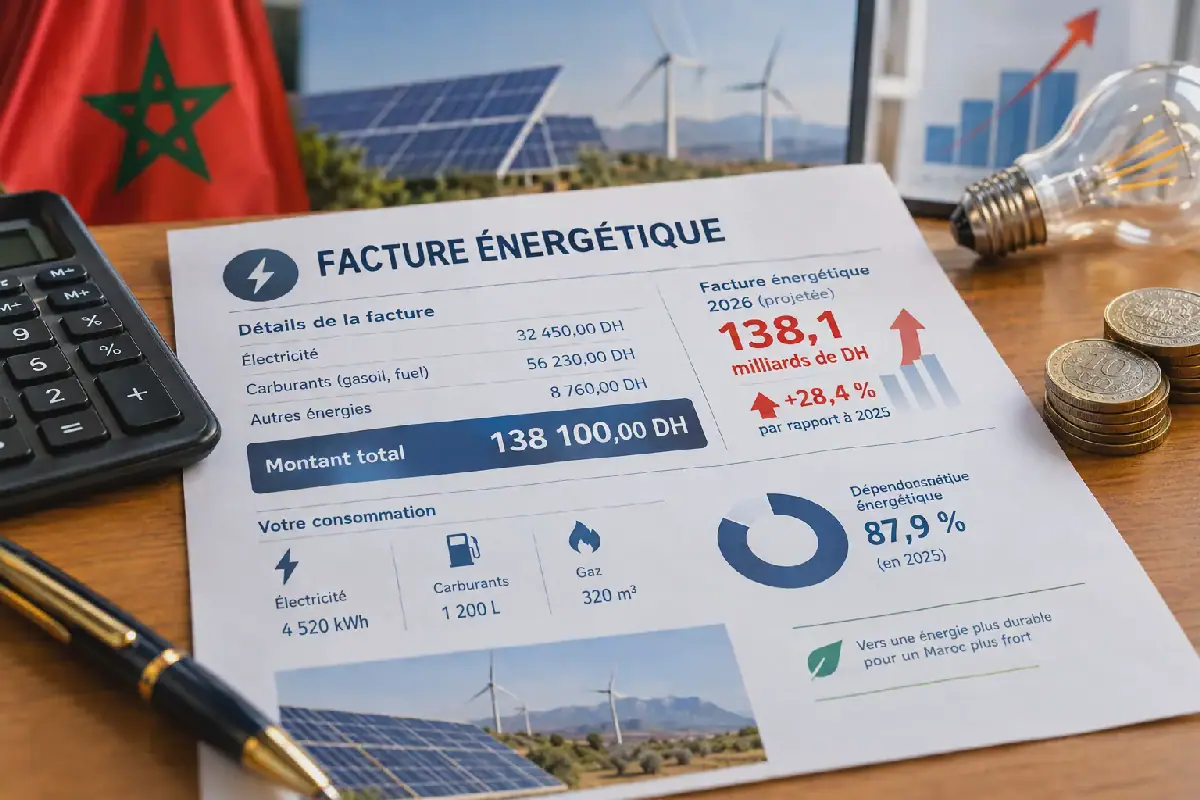
Morocco's reliance on imported hydrocarbons continues to weigh heavily on its energy bill. According to projections from Bank Al-Maghrib, the country's energy bill is expected to reach 138.1 billion dirhams in 2026, a significant increase of 28.4% from previous years. This rise is attributed to the surge in global hydrocarbon prices, which has resulted in increased pressure on Morocco's external accounts.
The impact of this increase is evident in the country's trade deficit, which is expected to widen to 4.6% of GDP in 2026, up from 2.4% in 2025. Economists point out that the root cause of this issue lies in the country's heavy reliance on imported energy sources. Despite progress in renewable energy, particularly in solar and wind power, Morocco remains largely dependent on foreign energy sources, with a dependence rate of 87.9% in 2025.
Economists, such as Mohammed Jadri, emphasize that the solution to this problem lies in the electrification of transportation and industry, accompanied by increased investment in energy efficiency and storage. Jadri notes that while Morocco has made significant strides in renewable energy, the bulk of its energy consumption still relies on imported hydrocarbons. He stresses that a reduction in energy consumption can be achieved through the adoption of electric vehicles, public transportation, and energy-efficient equipment.
The impact of rising energy costs is not limited to households, but also affects businesses across various sectors. As energy costs increase, companies face higher production costs, which can lead to reduced competitiveness, lower investment, and higher prices for consumers. Jadri notes that while some companies may absorb these costs, others may be forced to pass them on to consumers or reduce their investments.
According to data from the Ministry of Energy Transition, renewable energy sources accounted for 46.1% of Morocco's installed electricity capacity as of 2025. However, this does not necessarily translate to a significant reduction in energy imports, as the bulk of the country's energy consumption still relies on hydrocarbons. Jadri emphasizes that a distinction must be made between electricity and energy, noting that while Morocco has made significant progress in renewable electricity, its overall energy consumption remains largely dependent on imported hydrocarbons.
To mitigate the effects of rising energy costs, Jadri recommends accelerating the adoption of renewable energy sources, improving energy efficiency, and investing in energy storage and grid infrastructure. He also emphasizes the need for a comprehensive approach that addresses the root causes of Morocco's energy dependence, including the promotion of electric vehicles, public transportation, and energy-efficient equipment.
The Moroccan government has set ambitious targets to increase the share of renewable energy in its electricity mix, with a goal of exceeding 52% by 2030. The country's National Office for Electricity and Drinking Water (ONEE) has outlined a plan to achieve this goal, which includes investments in renewable energy, energy storage, and grid infrastructure. However, achieving these targets will require sustained efforts and investment in the energy sector.
Key points
- Morocco's energy bill is projected to reach 138.1 billion dirhams in 2026, a 28.4% increase from previous years.
- The country's reliance on imported hydrocarbons continues to weigh heavily on its energy bill, with a dependence rate of 87.9% in 2025.
- Economists recommend accelerating the adoption of renewable energy sources, improving energy efficiency, and investing in energy storage and grid infrastructure to mitigate the effects of rising energy costs.