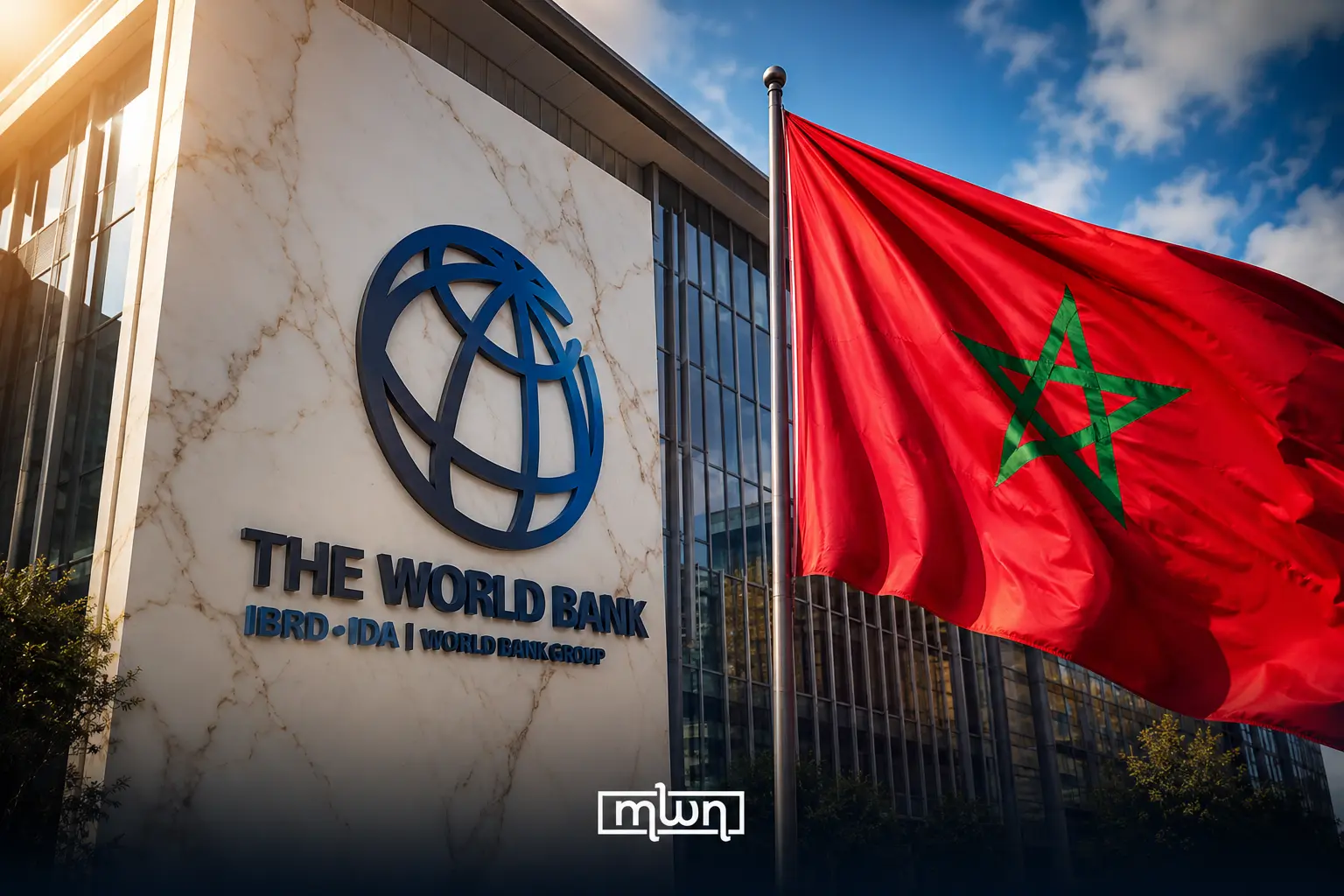
Morocco's economy is forecast to expand by 4.4% in 2026, despite a sharp downturn across much of the Middle East and North Africa. The World Bank's latest economic update for the Middle East, North Africa, Afghanistan, and Pakistan (MENAAP) region, places Morocco well ahead of the broader regional outlook. The MENAAP economy is expected to contract by 2.1% this year after 3.3% growth in 2025.
Morocco's growth is expected to ease from 4.9% in 2025 to 4.4% in 2026 before settling at 4% in 2027. The World Bank raised its 2026 forecast for Morocco by 0.2 percentage points from its April projection. It kept its 2027 forecast unchanged. The North African country entered 2026 with several favorable factors behind it, including better rainfall supporting agriculture, and public investment, tourism, and exports providing momentum.
The World Bank expects growth across developing oil-importing economies to rise from 3.9% in 2025 to 4.3% this year and 4% in 2027. Morocco's 4.4% forecast puts it ahead of the group average and well above Tunisia and Jordan, whose economies are expected to grow by 2.3% and 2.7%, respectively. Morocco also has the lowest projected inflation rate among the group, at 1.2% in 2026 and 1.8% in 2027.
Morocco's fiscal position also compares favorably with its peers. Its projected 3.5% deficit is narrower than the expected deficits in Jordan at 4.6%, Tunisia at 6%, and Egypt at 6.8%. However, the World Bank has flagged debt and financing pressures as significant risks for Morocco. The possibility of a stronger-than-usual El Niño event toward the end of 2026 could also create additional pressure, particularly through its impact on agriculture.
The World Bank's assessment goes beyond Morocco's near-term economic performance, arguing that governments across the region must prepare for a deeper transformation as artificial intelligence reshapes productivity and business. Morocco has several advantages as it enters this transition, including expanded exports of high-tech products. The country and Tunisia are the region's leading exporters of AI-related products.
Morocco is also seeking a larger role in the region's AI infrastructure, with the Nexus AI Factory, a $1.2 billion computing infrastructure project powered entirely by renewable energy. However, businesses still lag on AI adoption, with only 4.3% of establishments having adopted big-data analytics or AI in 2024. Cost and regulation remain the main barriers to adoption.
The World Bank sees cooperation across the region as one way to close gaps in computing infrastructure, human capital, data, and digital systems. For Morocco, the next economic challenge may therefore extend beyond surviving regional shocks, as it seeks to turn technological potential into widespread adoption of AI and more knowledge-intensive industries.
Key points
- Morocco's economy is forecast to grow 4.4% in 2026, driven by agriculture, tourism, public investment, and exports.
- The country's fiscal position compares favorably with its peers, with a projected 3.5% deficit.
- Morocco faces challenges in adopting AI, with cost and regulation remaining the main barriers.