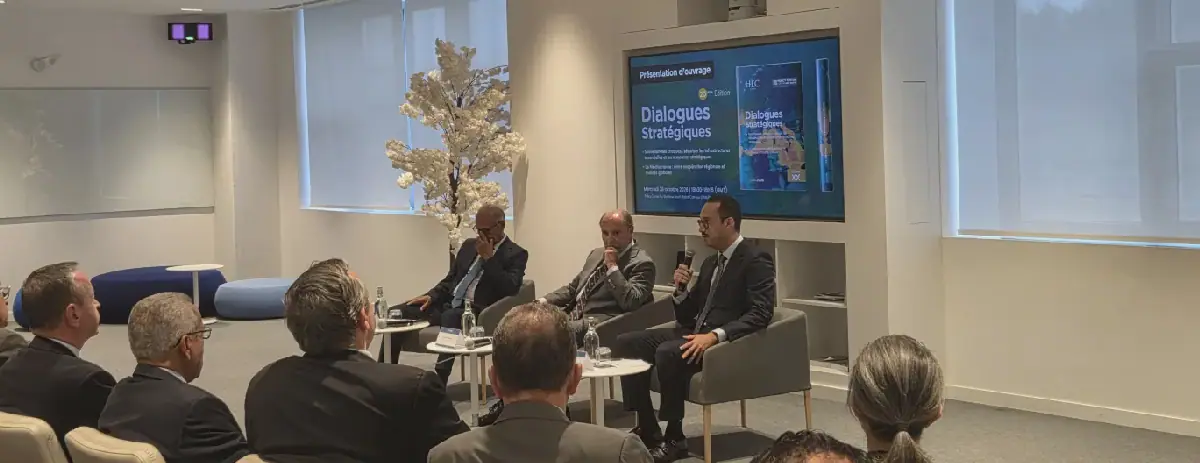
The 20th volume of the Strategic Dialogues, a joint publication of the Policy Center for the New South (PCNS) and the Center for Geopolitics at HEC Paris, was presented on October 28 in Rabat, Morocco. The event, held at the PCNS headquarters on the campus of the Mohammed VI Polytechnic University, brought together experts to discuss pressing issues related to Morocco's economic sovereignty and maritime trade routes. The discussions focused on the country's vulnerabilities, the Atlantic Initiative, and the role of national ports in a rapidly changing geopolitical environment.
The event featured Pascal Chaigneau, director of the Center for Geopolitics at HEC Paris, and Abdelhak Bassou, Senior Fellow at the PCNS, under the moderation of Oussama Tayebi, senior specialist in international relations at the PCNS. The Strategic Dialogues publication, a partnership between the PCNS and the Center for Geopolitics since 2016, explores critical issues in international relations. The 20th volume specifically examined critical sovereignties, including the security of strategic infrastructure and resources, and the Mediterranean region as a space for cooperation and international rivalries.
One of the key challenges facing Morocco's industry is the security of industrial supplies, particularly in the context of international tensions. Pascal Chaigneau highlighted the case of sulfur, a crucial input for the production of phosphoric acid and phosphate fertilizers. Morocco imports approximately 9 million tons of sulfur per year, and recent market fluctuations have led to significant price increases, from around $230 per ton to peaks of $900-1,200 per ton. Although prices have since stabilized around $790 per ton, the impact on Morocco's imports is estimated to be around $5.4 billion.
The example of sulfur illustrates the limitations of industrial sovereignty based solely on the availability of natural resources, without control over the entire supply chain. This vulnerability is particularly relevant for Morocco, which has significant national resources but relies on imports for key inputs. The country's dependence on international markets for essential goods highlights the need for a more comprehensive approach to economic sovereignty.
The discussions also touched on the implications of geopolitical tensions for international trade routes connecting Europe, Africa, and Asia. Abdelhak Bassou emphasized Morocco's strategic location at the intersection of the Mediterranean and Atlantic regions, as well as the importance of the Strait of Gibraltar for international exchanges. The current disruptions affecting certain maritime routes have significant implications for global trade and highlight the need for Morocco to adapt to changing circumstances.
The Atlantic Initiative, launched by Morocco, aims to promote cooperation and development in the Atlantic region. The initiative seeks to strengthen economic ties between countries in the region and promote a more stable and secure environment for trade and investment. The discussions at the Strategic Dialogues event highlighted the potential benefits of the Atlantic Initiative, including increased economic cooperation and improved regional stability.
In conclusion, the 20th volume of the Strategic Dialogues highlighted the critical issues facing Morocco in terms of economic sovereignty and maritime trade routes. The event provided a platform for experts to discuss the challenges and opportunities arising from the country's dependence on international markets and its strategic location in the Mediterranean and Atlantic regions. The discussions emphasized the need for Morocco to develop a comprehensive approach to economic sovereignty, including the security of strategic infrastructure and resources.
Key points
- Morocco's economic sovereignty is vulnerable to international market fluctuations, particularly in the context of essential goods such as sulfur.