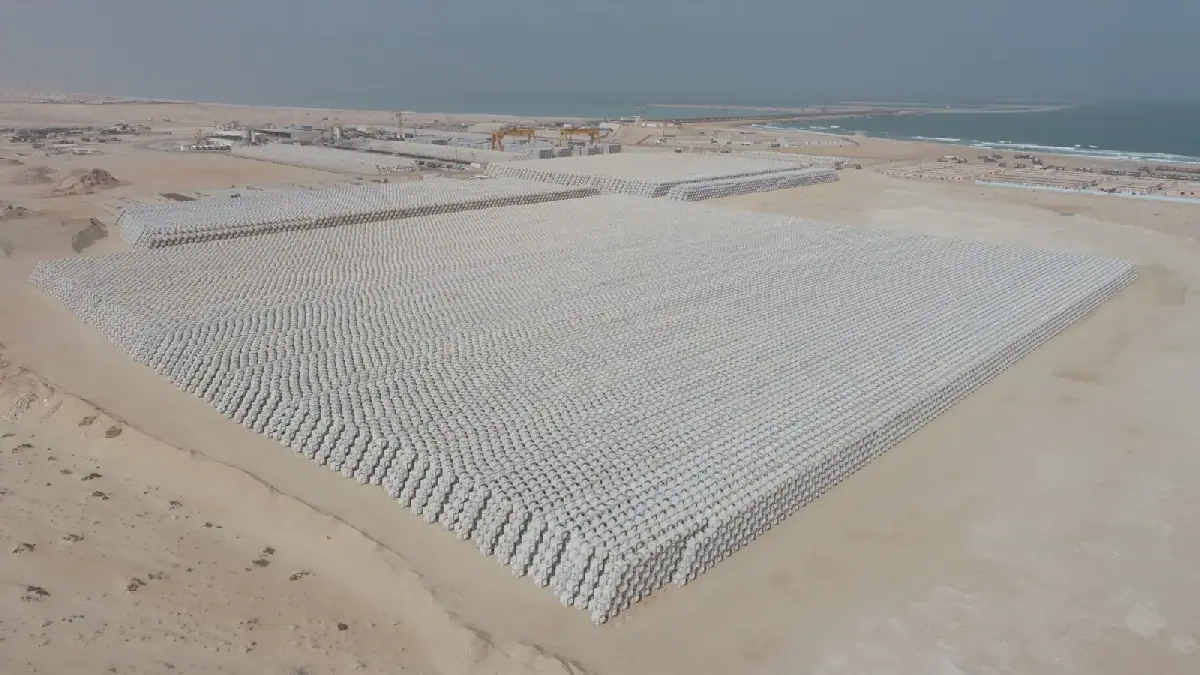
The Dakhla Atlantique port in Morocco is set to significantly enhance its container handling capacity and strengthen its position as a major logistics hub on the Atlantic coast of Africa. With an expected annual capacity of two million twenty-foot equivalent units (EVP), the port aims to primarily cater to Morocco's national trade needs, including imports and exports for local industries and logistics activities. According to Nisrine Iouzzi, the project manager for the port complex, this capacity will support the region's growing industrial and logistical sectors.
The port's development strategy focuses on integrating maritime infrastructure with road networks and economic activities in its hinterland. While the primary goal is to serve domestic trade and industrial development, Iouzzi notes that international transshipment could also be a possibility, depending on commercial opportunities and demand from shipping companies. However, this would be a complementary activity, with the main focus on facilitating trade and industrial growth in the region.
Another key development axis for Dakhla Atlantique is its connection to Sahel countries. The port's integration with Morocco's national road network could provide new opportunities for transporting goods between international markets and Sahelian economies. This aligns with the Royal Initiative to facilitate Sahel countries' access to the Atlantic Ocean. Iouzzi highlights that the port's geographical position and land connectivity will enable combined maritime and international road transport solutions.
The success of this initiative depends on several factors, including the establishment of effective corridors, cooperation agreements, shipper choices, and logistics operator commitments. Iouzzi emphasizes that Dakhla Atlantique's challenge will be to create an integrated logistics offer that ensures continuity between maritime services, international road transport, and industrial and logistics zones.
In a West African context where several ports are modernizing, Iouzzi prefers to focus on complementarity rather than direct competition. She views this dynamic as an opportunity for development and cooperation rather than a simple competitive logic between ports. The growth of port capacities in Africa is part of a broader transformation in African trade, with increased flows potentially justifying diversified corridors and logistics solutions.
For Dakhla Atlantique to succeed, it must attract economic operators and develop regular shipping services. Iouzzi notes that the port's ability to offer integrated logistics solutions will be crucial in this regard. The development of Dakhla Atlantique and similar ports could have a significant impact on African trade, enabling greater connectivity and economic cooperation between countries.
As the Dakhla Atlantique port project moves forward, its impact on regional and international trade will be closely watched. With its strategic location and planned capacity, the port is poised to play a significant role in Morocco's and Africa's economic development. The port's success will depend on effective collaboration between stakeholders, including logistics operators, shipping companies, and governments.
Key points
- Dakhla Atlantique port aims to primarily cater to Morocco's national trade needs with an expected annual capacity of two million EVP.
- The port's development strategy focuses on integrating maritime infrastructure with road networks and economic activities in its hinterland.
- Dakhla Atlantique's connection to Sahel countries could provide new opportunities for transporting goods between international markets and Sahelian economies.