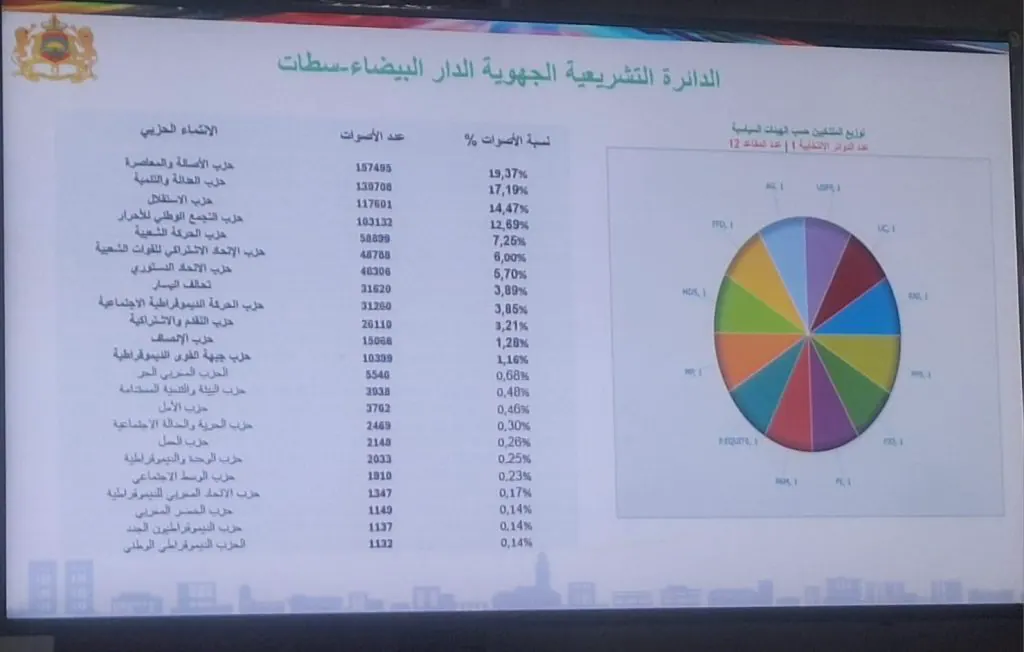
The Casablanca-Settat region in Morocco has disclosed the initial results of its legislative elections, which took place on September 24, 2026. According to the provisional tally, the PAM party has secured the top spot with 19.37% of the votes cast. The party's performance has positioned it as a significant player in the region's new political landscape. These preliminary results provide an insight into the shifting dynamics within the region.
The PAM is closely followed by the PJD, which garnered 17.19% of the votes, and the Istiqlal party, which secured 14.47%. The RNI party also made a notable showing, capturing 12.69% of the vote, while the Parti du Mouvement populaire obtained 7.25%. These figures reflect the diverse political preferences of the region's electorate. The varied performances of these parties underscore the complexity of the region's political scene.
The voter turnout in the Casablanca-Settat region was recorded at 34.6%, with over 1.13 million electors participating in the elections out of a total of 2.9 million registered voters. This participation rate indicates a moderate level of engagement from the eligible voting population. The region's electoral process appears to have been conducted with a reasonable degree of public involvement.
The Casablanca-Settat region's legislative elections were part of a broader national process aimed at renewing the country's parliamentary representation. The elections sought to reflect the will of the Moroccan people and determine the future composition of the national legislature. As one of the country's most populous regions, Casablanca-Settat plays a crucial role in Morocco's political landscape.
The release of these preliminary results marks an important step in Morocco's electoral process. The final results will be determined after the completion of the counting and verification process. The confirmed outcomes will likely influence the formation of the new government and the distribution of parliamentary seats.
Morocco's legislative elections are a significant event in the country's democratic process, offering citizens the opportunity to choose their representatives. The elections are also seen as a reflection of the nation's commitment to democratic principles and the peaceful transfer of power. The involvement of various political parties and the public's participation underscore the importance of these elections.
The PAM's lead in the Casablanca-Settat region, based on the preliminary results, positions it as a key player in the national legislative assembly. The party's performance, along with that of other parties, will contribute to the overall composition of Morocco's parliament. The final distribution of seats will determine the balance of power and influence within the legislative body.
Key points
- The PAM party leads in the Casablanca-Settat region with 19.37% of the vote.
- The PJD and Istiqlal parties follow closely, with 17.19% and 14.47% of the votes, respectively.
- The voter turnout in the region was 34.6%, with over 1.13 million electors participating.