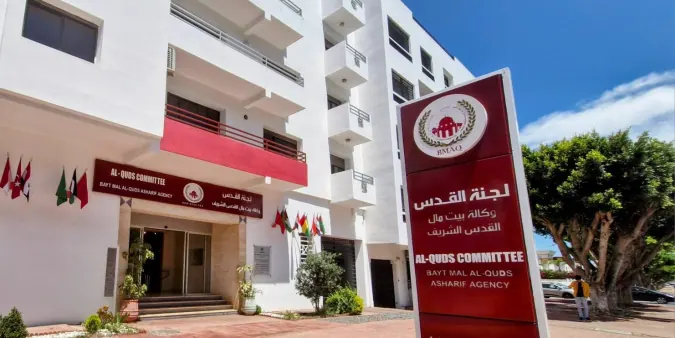
Morocco's Bayt Mal Al-Quds Acharif Agency is developing its 2027-2030 action plan as part of its Vision 2030. The agency held three days of consultations with Palestinian institutional, economic, and social partners in Ramallah and Al-Quds. These meetings aimed to gather proposals on priorities and future cooperation to shape a plan that responds to Al-Quds' needs while following the principle of sustainability in planning and action.
The consultations, led by Mohamed Salem Cherkaoui, the agency's director in charge of management, brought together representatives of Palestinian institutions, religious authorities, businesses, and civil society. Participants included the PLO's Department of Jerusalem Affairs, the Ministry of Jerusalem Affairs, the Jerusalem Governorate, Islamic and Christian bodies, the Directorate of Education and Teaching, the East Jerusalem Hospitals Network, the Chamber of Commerce and Industry, Al-Quds University, and the Bank of Palestine.
The agency also formed an advisory committee made up of Jerusalem figures from religious, economic, and social backgrounds. This committee will contribute to the Vision 2030 process and review a preliminary draft prepared by agency experts. Cherkaoui stated that the new vision draws on the High Directives of King Mohammed VI, Chairman of the Al-Quds Committee, as well as the values that guided the agency's creation and its field experience since 1998.
The new vision aims to gradually move from direct in-kind assistance toward empowerment and sustainability. The agency plans to build on its experience supporting productive associations, emerging businesses, traders, and farmers. Priorities include governance, digitalization, and compliance with international quality standards. The agency will increase its use of electronic platforms to improve transparency, monitoring, and evaluation.
The agency will also focus on diversifying funding sources, developing an electronic donation platform, expanding productive waqf, promoting the "Made for Palestine" label, and mobilizing corporate social responsibility. Morocco has fully funded the agency since 2011, with no funding from another party since then. The agency spends around $3 million a year on operating costs and nearly $4 million on projects.
During the next phase, the agency will focus on preserving Al-Quds' historical, civilizational, and cultural heritage while strengthening residents' resilience through economic and social empowerment programs. The Vision 2030 plan covers trade, tourism, agriculture, digital transformation, a regional innovation center, and a unified and secure information system. The agency will treat Jerusalem's residents as partners in planning and implementation rather than simply as beneficiaries.
Palestinian officials and religious representatives welcomed the agency's work during the consultations. They praised the agency's education, social development, and economic empowerment programs and called for their continuation and expansion. The agency's efforts have received support from various stakeholders, including Adnan Al-Husseini, Sheikh Azzam Al-Khatib, William Shomali, and Archbishop Atallah Hanna.
Key points
- The Bayt Mal Al-Quds Agency is shifting its focus from direct aid to long-term empowerment and sustainability in its Vision 2030 plan for Jerusalem.
- The agency's plan aims to preserve Al-Quds' historical, cultural heritage while strengthening residents' resilience through economic and social empowerment programs.
- The agency will increase its use of electronic platforms to improve transparency, monitoring, and evaluation, and diversify funding sources to support its activities.