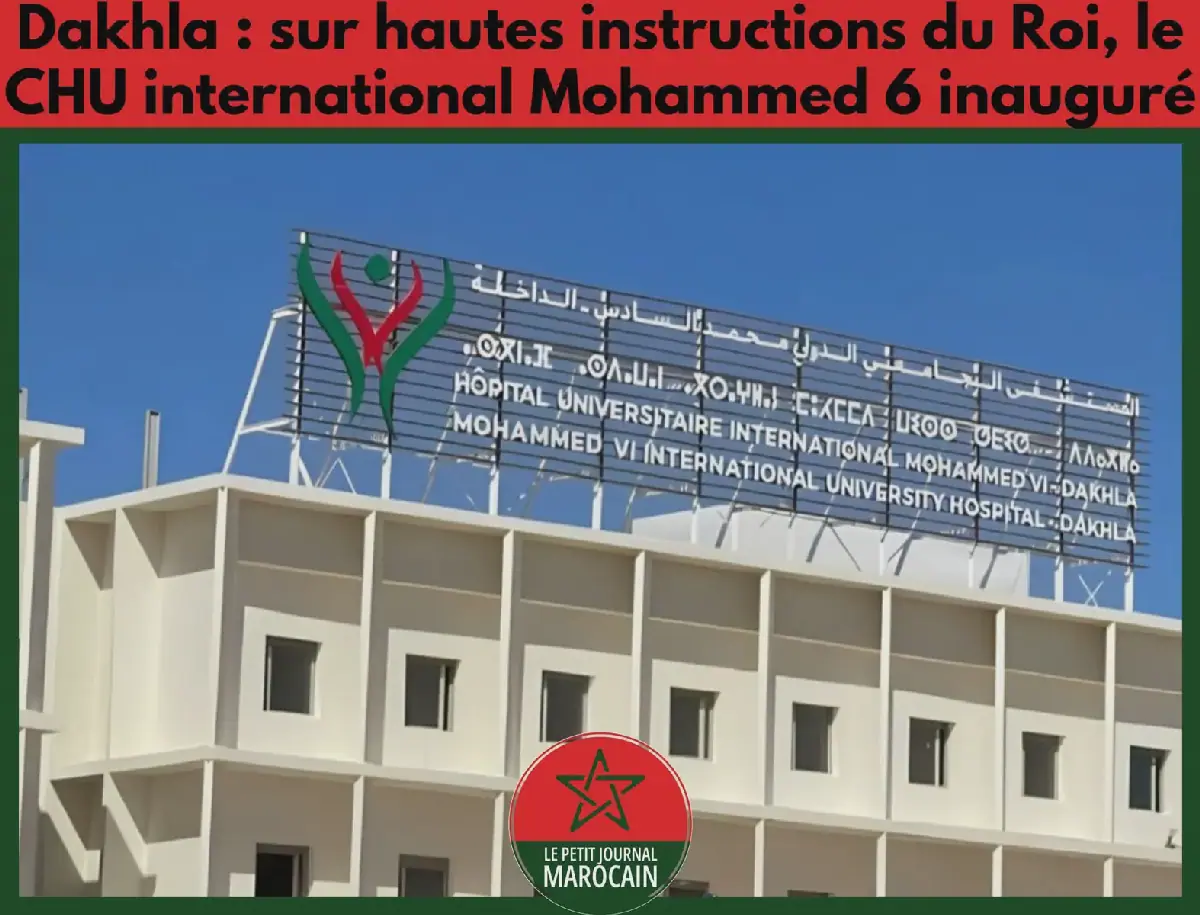
The new Complexe hospitalo-universitaire international Mohammed VI in Dakhla, Morocco, was inaugurated on November 18, two days before the second global health summit in Africa. The complex was built on 47 hectares and features a hospital, medical training facilities, research infrastructure, and residential areas. This development is part of Morocco's ambition to make Dakhla a major healthcare hub on the continent. The complex is expected to enhance healthcare services in the southern provinces and neighboring African countries.
The complex spans 470,000 square meters and is organized into three main areas: hospital, university, and residential. It includes a 259-bed hospital, a university with a capacity for 2,600 students, a medical simulation center, a conference center, and various accommodation and service facilities. The hospital is the main component of the complex, covering 43,950 square meters and offering 259 beds, including 51 for critical care. It can accommodate up to 226,000 patients annually for inpatient and outpatient services.
The hospital provides services in 28 specialties, including cardiology, cardiovascular surgery, neurosurgery, oncology, obstetrics and gynecology, pediatrics, nephrology, and emergency medicine. It also features 11 centers of excellence in areas such as interventional cardiology, neurosurgery, orthopedic surgery and traumatology, nuclear medicine, adult and pediatric onco-hematology, and radiation therapy. The hospital is equipped with a 24/7 medical imaging service, an automated medical biology laboratory, and hyperbaric oxygen therapy facilities.
The hospital's technical platform comprises 15 operating rooms, including ten in the central operating block, two catheterization rooms, two endoscopy rooms, and one emergency room. The complex also includes the Université Mohammed VI des Sciences et de la Santé (UM6SS) in Dakhla, covering 70,000 square meters and accommodating 2,600 students. The university comprises several medical, paramedical, and health sciences training institutions.
The university features a faculty of medicine, nursing sciences, and health professions, as well as a biomedical engineering school. These infrastructure developments aim to strengthen Morocco's healthcare offer in the southern provinces and neighboring countries. The complex is expected to become a major healthcare hub in Africa, providing quality medical services and training to students.
The Mohammed VI Foundation for Health and Sciences initiated the project to improve healthcare services and medical training in the region. The complex will also serve as a center for medical research and innovation. By establishing this complex, Morocco aims to enhance its presence in the African healthcare sector and provide better services to the local population and neighboring countries.
The inauguration of the complex is a significant step towards achieving Morocco's healthcare goals in the region. With its state-of-the-art facilities and comprehensive services, the complex is poised to make a positive impact on the healthcare landscape in Africa. The project demonstrates Morocco's commitment to improving healthcare services and medical training in the region.
Key points
- The complex features a 259-bed hospital with services in 28 specialties and 11 centers of excellence.
- The university has a capacity for 2,600 students and offers training in various medical and health sciences disciplines.
- The complex aims to make Dakhla a major healthcare hub in Africa, enhancing services in the southern provinces and neighboring countries.
Reporting sources
- Dakhla : Inauguration du nouveau complexe hospitalo-universitaire Mohammed VI · Agence Nigérienne de Presse