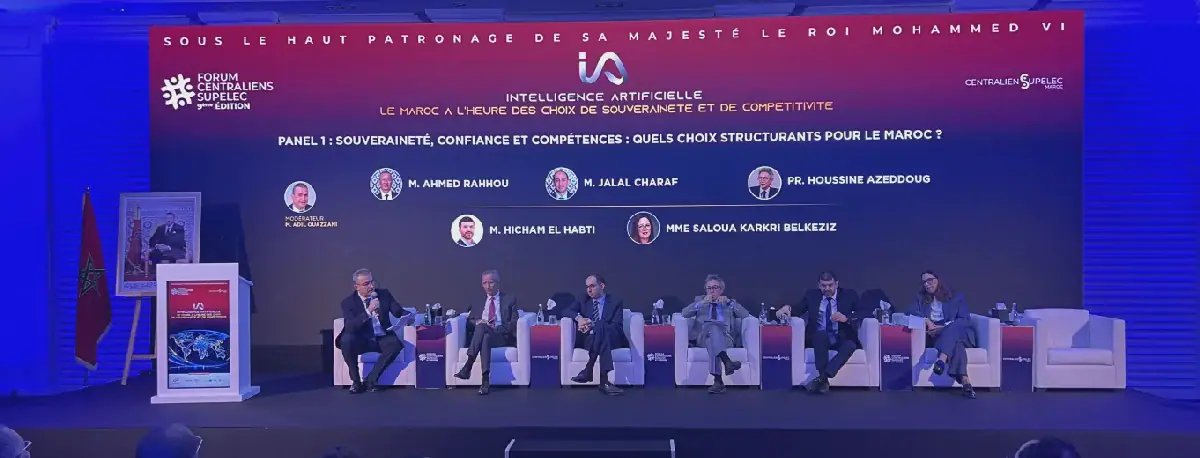
The Centraliens Supélec Forum, now in its ninth edition, took place in Casablanca, Morocco, on November 22-23. Organized by the Association of Centraliens and Supélec of Morocco, the event gathered ministers, public decision-makers, private sector representatives, researchers, and national and international experts. The forum's theme, "Artificial Intelligence: Morocco facing sovereignty and competitiveness choices," reflects the country's efforts to integrate into the global AI value chain and identify national priorities for technological development.
The forum's discussions centered on the technological capabilities Morocco could develop, the dependencies it must consider, and the economic opportunities linked to AI adoption. With the acceleration of investments and innovations in AI, participants examined the means to strengthen Morocco's digital sovereignty in a technology environment dominated by international players. The goal is to develop local competencies, infrastructure, and innovation capacities, rather than just adopting existing solutions.
According to Amal Hmouri, director of the forum, AI represents more than a technological revolution; it presents choices that will shape Morocco's future. Hmouri emphasized that the objective should not only focus on adopting new tools but also on mastering technologies, developing talents, and creating economic value. She stressed that the real challenge is not just adopting AI but giving Morocco the means to control its levers, develop talents, and transform AI's potential into economic value.
The forum's program included four thematic workshops on strategic priorities, held on November 22. These working sessions allowed participants to share analyses, identify obstacles to AI development, and formulate operational recommendations. One of the workshops focused on digital sovereignty and positioning Morocco in the AI economy, from research and development to industrial applications and services.
The event's emphasis on sovereignty and competitiveness reflects Morocco's efforts to leverage AI as a driver of economic development. By examining the implications of AI on the country's economy and sovereignty, participants aimed to identify opportunities and challenges. This aligns with Morocco's ongoing digital transformation efforts, which seek to harness AI's potential for economic growth.
The forum's discussions also touched on the importance of developing local talent and innovation capacities. By investing in human capital and infrastructure, Morocco aims to strengthen its position in the global AI landscape. This approach would enable the country to benefit from AI's economic potential while minimizing dependencies on external actors.
As the forum concluded, participants likely gained a deeper understanding of the complex relationships between AI, sovereignty, and competitiveness. The event's outcomes may inform Morocco's future strategies for AI development and integration into the global economy. Key stakeholders will likely continue to engage in discussions on AI's implications for the country's economy and society.
Key points
- The forum highlighted the need for Morocco to develop local AI competencies and infrastructure to strengthen its digital sovereignty.
- The event brought together a diverse range of stakeholders, including ministers, public decision-makers, and private sector representatives.
- The forum's discussions focused on the economic opportunities and challenges linked to AI adoption in Morocco.