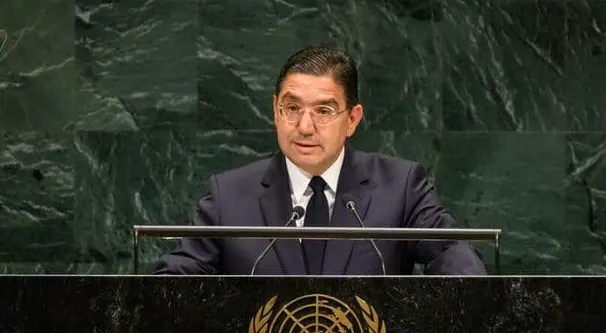
Morocco's Minister of Foreign Affairs, Nasser Bourita, delivered a significant address at the 81st Session of the United Nations General Assembly. Speaking on behalf of King Mohammed VI, Bourita emphasized the need for the global community to confront non-state armed groups. He noted that over 200 million people worldwide live under the control of these armed actors. Bourita called for firm international deterrence against these groups and their state sponsors.
Bourita's address highlighted the need for a fundamental shift in how international powers engage with Africa. He rejected stereotypical narratives that portray Africa as a continent of conflicts and problems. Instead, Bourita presented Africa as a resilient region capable of formulating its own solutions. He invoked King Mohammed VI's principle that "Africa must trust Africa," citing transformative continental projects as proof of African-led leadership and economic integration.
Morocco detailed major commitments to climate action and international peacebuilding. Bourita announced Morocco's target to cut greenhouse gas emissions by up to 53% by 2035. He also championed regional cooperation through African Climate Commissions established for the Congo Basin, the Sahel, and African Island States. These efforts aim to address the continent's acute vulnerability to climate impacts.
On regional security, Morocco reaffirmed its support for a two-state solution in the Middle East. The country confirmed its active participation in the Gaza international stabilization force. Additionally, Bourita noted that Security Council Resolution 2797 has placed the Moroccan Sahara dispute on an irreversible path toward a final settlement based solely on Moroccan autonomy.
Morocco officially announced its candidacy for a non-permanent seat on the UN Security Council for the 2028–2029 term. Bourita stated that the bid represents "a kingdom with a diplomatic heritage spanning several centuries" dedicated to upholding multilateralism, peace, and sustainable development. This move aims to cement Morocco's role as a bridge between Africa and global governance.
By linking continental resilience with global accountability, Morocco's address delivered a strong message that Africa is ready to shape the future of international diplomacy. The address emphasized the need for African-led solutions and highlighted the continent's potential as a hub of opportunity. Morocco's vision for African solidarity and cooperation resonated with the international community.
The international community has taken note of Morocco's proactive stance on global issues. The country's efforts to promote African-led solutions and its commitment to climate action and peacebuilding have been acknowledged. As Morocco prepares to take on a more prominent role in global governance, its vision for African solidarity is expected to have a lasting impact on international diplomacy.
Key points
- Morocco's Foreign Minister Nasser Bourita urges the global community to confront non-state armed groups and promote Africa as a hub of opportunity.
- Morocco commits to cutting greenhouse gas emissions by up to 53% by 2035 and champions regional cooperation through African Climate Commissions.
- Morocco announces its candidacy for a non-permanent seat on the UN Security Council for the 2028–2029 term, aiming to uphold multilateralism, peace, and sustainable development.