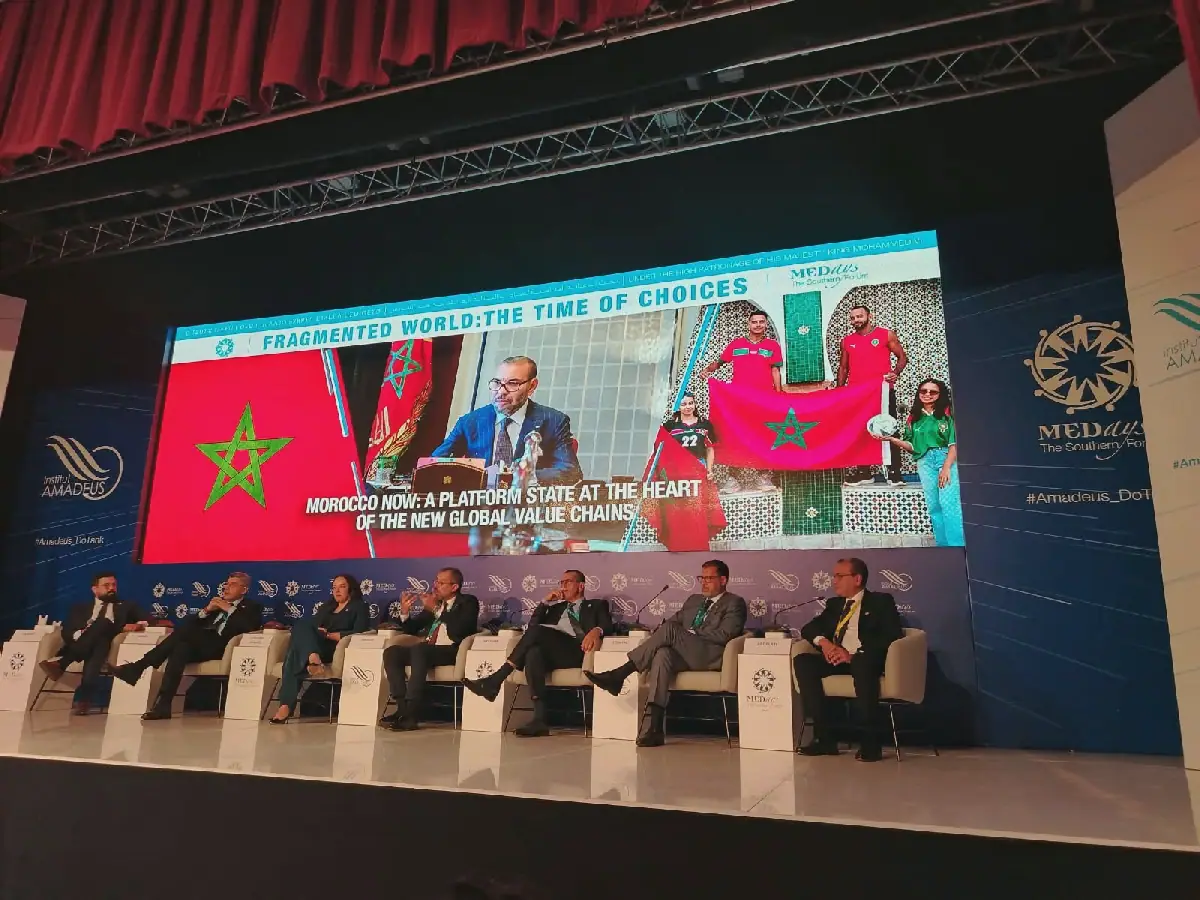
The Moroccan government has made significant strides in enhancing its economic model, transforming into a 'platform-state' that can absorb current geo-strategic changes and reshape global value chains. This development was discussed during a thematic session at the Midea Investment Summit in Tangier, attended by government officials, institutional and financial stakeholders. The session focused on the attractiveness of Morocco's economic model and its potential to integrate its national productive fabric and secure financing for investment projects.
The automotive industry in Morocco has seen substantial growth, with 270 equipment manufacturers, including two major global players, Renault and Stellantis. Over 95% of the national production is exported to European markets. According to Mariah El Wazani Al Shuhadi, Head of Automotive & Electric Mobility at the Moroccan Agency for Investment and Export Development, the local integration rate in the automotive sector has reached 69%, up from 40% when the industry began. The goal is to achieve 80% integration by attracting new production links.
Morocco has made significant investments in the electric mobility sector, becoming one of the few countries to localize the production of electric vehicle batteries. The country benefits from competitive renewable energies and a well-structured vocational training system. The integration of new production facilities, such as the Sentury Tire factory in Tangier, has contributed 5 percentage points to the local integration rate.
However, accessing financing remains a challenge for many investors. Saïd Jabrani, General Manager of the National Guarantee and Financing Company (Tamwilcom), emphasized that the primary obstacle is not the lack of liquidity but rather the absence of viable economic models and guarantees. Tamwilcom intervenes to share risks with the banking sector, covering up to 70% of investment and operating loan values for eligible companies.
The National Agency for the Promotion of Small and Medium-sized Enterprises (Maroc PME) is working to support small and medium-sized enterprises through three main pillars: qualification, connection, and local anchoring. The agency aims to help these enterprises meet the standards of large businesses and connect them with financing and guarantee institutions.
The tourism and industrial real estate sectors are also crucial to Morocco's economic development. The Moroccan Company for Tourist Engineering (SMIT) is working to establish a diversified tourism model that combines quality, environmental friendliness, and varied activities. The MEDZ company, a subsidiary of the Deposit and Management Fund (CDG), is focused on building integrated industrial systems.
The stability and credibility of Morocco's institutions are critical factors in attracting foreign investors. According to experts, investors prioritize a stable and reliable business environment when choosing a location for their projects. Morocco's macroeconomic performance, including a 91% increase in foreign direct investment in 2025 and a growth rate of 4.9%, demonstrates its potential for growth and development.
Key points
- Morocco aims to increase local integration in the automotive industry to 80%.
- The country is transforming into a 'platform-state' to absorb geo-strategic changes.
- Morocco has localized the production of electric vehicle batteries, benefiting from competitive renewable energies.
Reporting sources
- المغرب يرفع الاندماج المحلي في صناعة السيارات إلى 69 % ويراهن على «الدولة-المنصة» · Al Ittihad Al Ichtiraki