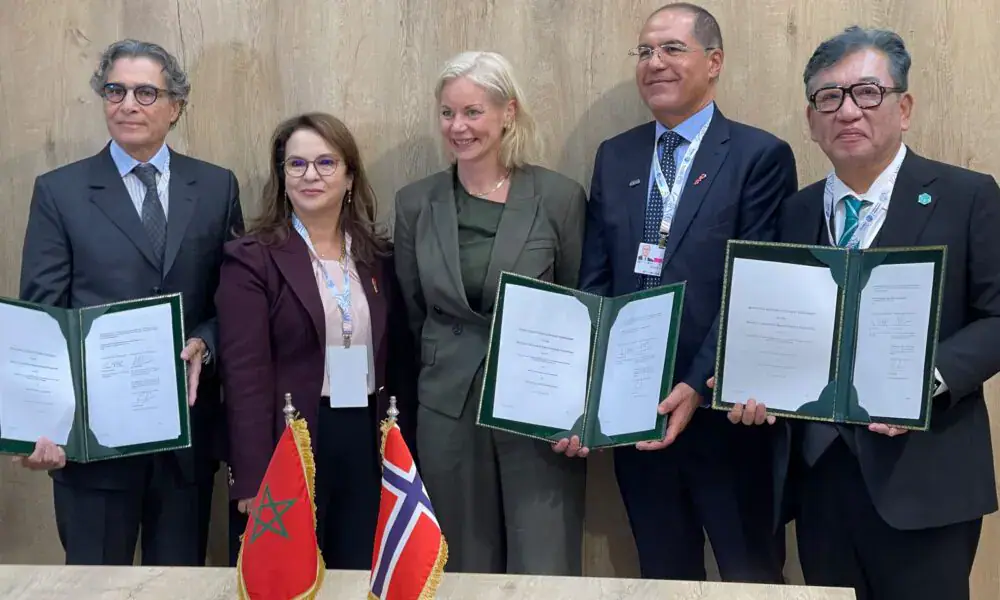
Morocco and Norway have signed an agreement to mobilize carbon financing for renewable energy projects in Morocco. The agreement was signed on Thursday in Antalya, Turkey, on the sidelines of COP31. The deal brings together the Caisse de Dépôt et de Gestion (CDG), Casablanca Finance City Authority (CFCA), and the Global Green Growth Institute (GGGI). The agreement aims to support the development of renewable energy projects in Morocco, particularly in the solar and wind sectors.
The agreement is part of a bilateral deal between Morocco and Norway, signed in May 2026, under Article 6.2 of the Paris Agreement. The program will use a "Generation-Based Incentive" (GBI) mechanism, which provides financial incentives for reductions in emissions that are actually achieved, measured, and verified. The initiative will focus on new solar and wind installations, including those with battery storage capacity.
The agreement was signed in the presence of Moroccan Minister of Energy, Mines, and Sustainable Development Charafat Afailal and Norwegian Minister of Climate and Environment Sigrun Aasland. The signatory organizations were represented by their respective CEOs, Saïd Ibrahimi for CFCA and Khalid Safir for CDG. The deal is expected to contribute to Morocco's Nationally Determined Contribution (CDN 3.0) and support the country's transition to renewable energy.
The program aims to generate up to 8 million tons of CO2 reductions over a 10-year period, equivalent to deploying around 2 GW of renewable energy production capacity. Africa Carbon Link (ACL), a joint initiative by CDG and CFCA, will be responsible for implementing the program. ACL will act as an aggregator and fund manager, mobilizing project developers and ensuring the smooth operation of carbon transactions and associated financial flows.
The initiative is part of Morocco's efforts to develop innovative climate financing mechanisms and structure its carbon market. The program also aligns with Morocco's priorities to accelerate the development of renewable energies, strengthen energy sovereignty, and mobilize innovative financing. The agreement demonstrates the potential of carbon markets as a lever for financing the energy transition.
Moroccan officials have welcomed the agreement, highlighting its potential to support the country's climate ambitions and position Casablanca as a reference platform for climate finance in Africa. Charafat Afailal noted that the partnership illustrates the concrete impact of Article 6 of the Paris Agreement, while Saïd Ibrahimi emphasized the potential of carbon markets to finance the energy transition.
The agreement between Morocco and Norway demonstrates the growing cooperation between countries to address climate change. The deal is expected to have a positive impact on Morocco's renewable energy sector and contribute to the country's efforts to reduce its greenhouse gas emissions. The partnership also highlights the importance of international cooperation in mobilizing financing for climate action.
Key points
- Morocco and Norway have signed an agreement to mobilize carbon financing for renewable energy projects in Morocco, aiming to generate up to 8 million tons of CO2 reductions over 10 years.