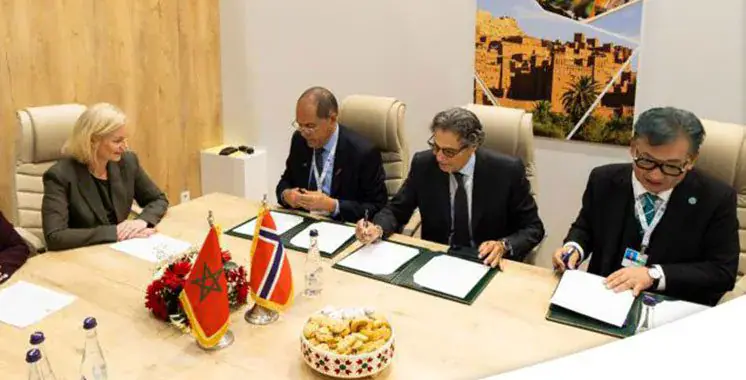
Morocco and Norway have taken a significant step forward in their climate cooperation with the signing of a strategic agreement on carbon financing. The deal, reached on the sidelines of COP31 in Antalya, Turkey, brings together the Caisse de dépôt et de gestion (CDG) and Casablanca Finance City Authority (CFCA) with a Norwegian fund represented by the Global Green Growth Institute (GGGI). This partnership aims to mobilize carbon financing to support the development of new renewable energy projects in Morocco.
The agreement, which falls under Article 6.2 of the Paris Agreement, is expected to generate up to 8 million tons of CO2 equivalent in emission reductions over a 10-year period. This is potentially equivalent to deploying around 2 GW of renewable energy production capacity, primarily in solar and wind power. Africa Carbon Link (ACL), a joint initiative by CDG and CFCA, will act as the aggregator and manager of the program, ensuring its operational implementation and contributing to project structuring and financing mobilization.
The partnership is seen as a significant step towards achieving Morocco's renewable energy ambitions. The country aims to increase the share of renewables in its installed electricity capacity to over 52% by 2030 and reduce greenhouse gas emissions by 53% by 2035. The program also aligns with Norway's efforts to support climate action in developing countries. Sang-Hyup Kim, executive director of GGGI, highlighted the importance of this cooperation, noting that it will support the development of commercially viable projects in solar, wind, and battery storage.
The Global Green Growth Institute (GGGI) is an intergovernmental organization dedicated to promoting sustainable economic growth in developing countries. Since its establishment in 2012, GGGI has grown from 18 founding members to over 50 members and 29 partner countries. The institute's Strategy 2030 aims to support countries in achieving their climate and development goals, including nationally determined contributions (NDCs) and Sustainable Development Goals (SDGs).
The partnership between Morocco and Norway is expected to serve as a model for high-integrity cooperation under Article 6 of the Paris Agreement. GGGI's Kim emphasized that the program's success will depend on strong national ownership and robust guarantees. The initiative is also seen as a significant step towards mobilizing financing for climate action in Africa. With the first transfers of emission reductions expected to take place from 2028, the program is set to make a tangible impact on Morocco's renewable energy sector.
The agreement between Morocco and Norway is a testament to the growing cooperation between countries in the area of climate action. As the world moves towards a low-carbon economy, partnerships like this one will be crucial in mobilizing financing for renewable energy projects. Morocco's CDG and CFCA have demonstrated their commitment to supporting the development of the country's renewable energy sector, and this partnership with Norway is expected to yield significant results.
As the global community continues to grapple with the challenges of climate change, partnerships like this one offer a glimmer of hope. The cooperation between Morocco and Norway serves as a model for other countries to follow, demonstrating the potential for collaborative action on climate change. With the focus on mobilizing financing for renewable energy projects, this partnership is set to make a positive impact on the environment and support sustainable economic growth in Morocco.
Key points
- Morocco and Norway have partnered to support the development of new renewable energy projects, with a focus on solar and wind power.
- The partnership aims to generate up to 8 million tons of CO2 equivalent in emission reductions over a 10-year period.
- The program is expected to mobilize financing for climate action in Africa and serve as a model for high-integrity cooperation under Article 6 of the Paris Agreement.
Reporting sources
- Financement carbone : La CDG et CFCA s’allient à un fonds norvégien · Aujourd'hui Le Maroc