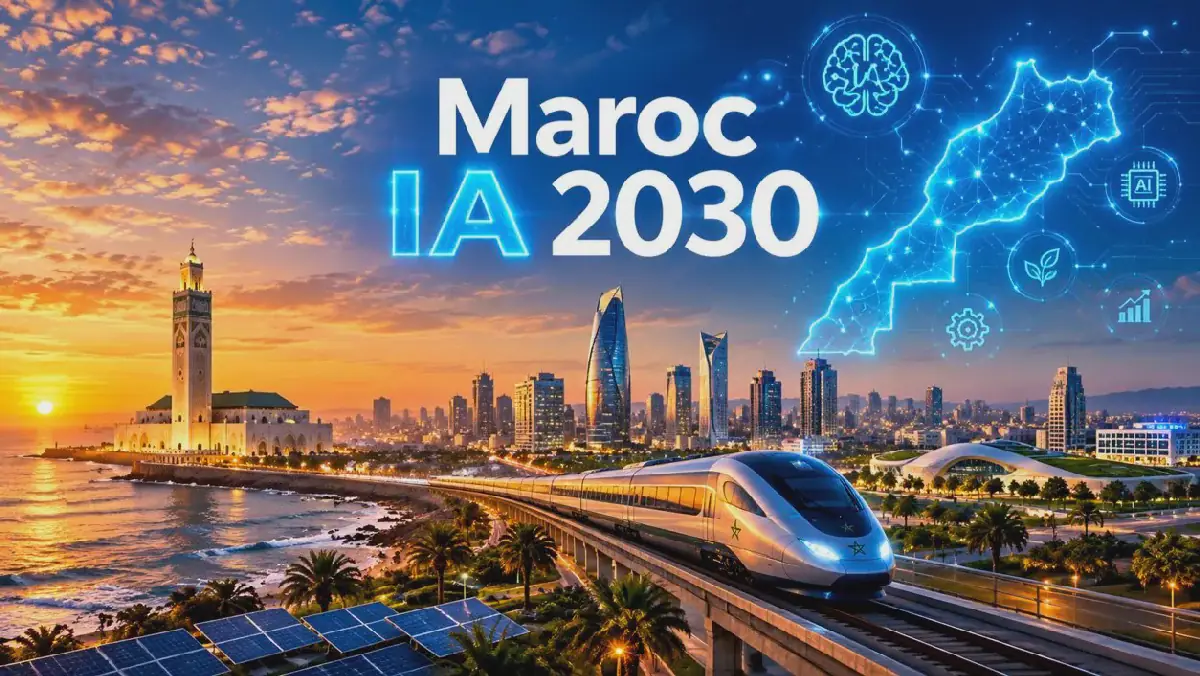
Morocco is seeking to transform its economy by leveraging artificial intelligence (AI). The government has set ambitious targets, aiming to add $100 billion to the country's GDP, create 50,000 jobs, and train or certify 200,000 AI talents by 2030. To achieve this, Morocco is creating a dedicated ministry for AI, with Ahmed Rahhou, former president of the Competition Council and ex-head of CIH Bank, appointed as the minister of AI, digital transformation, and administrative reform.
The government's strategy, outlined in the "Morocco AI 2030" roadmap, focuses on three main pillars: sovereignty and trust, innovation and competitiveness, and impact, adoption, and influence. The plan includes ten key programs covering areas such as regulation, infrastructure, shared platforms, linguistic models, financing, human capital, and performance measurement. Experts emphasize that the policy must be aligned with industry, higher education, vocational training, and energy strategy to ensure successful implementation.
The creation of a dedicated AI ministry is seen as a significant step towards achieving Morocco's goals. However, experts caution that the real challenge lies in translating this ambition into measurable gains in productivity, public services, and exportable digital capabilities. Hamid Kerchaoui, an AI expert, notes that the policy must be operationalized through clear responsibilities, financing, and decision-making to drive innovation and competitiveness.
The economic stakes are high, with AI potentially transforming various sectors such as industry, agriculture, logistics, banking, and services. To benefit from AI, Moroccan companies must integrate the technology into their processes, train their teams, and identify areas where AI can generate measurable gains. The government plans to establish a network of JAZARI institutes to structure research, training, and innovation, with four components already established in September 2026.
The effectiveness of these initiatives will be measured by their impact on the economy, including the number of patents, industrialized prototypes, companies supported, and qualified jobs created. Experts warn that there is a risk of confusing the creation of an institutional ecosystem with the emergence of a viable AI industry. To assess Morocco's progress, more precise indicators are needed, such as the proportion of companies using AI, productivity gains, private investments mobilized, and revenues generated by locally developed solutions.
The development of AI in Morocco also raises questions about the role of small and medium-sized enterprises (SMEs). While large companies have more resources to invest in AI, SMEs face challenges in adopting the technology due to costs, data availability, and uncertainty about returns on investment. Experts stress that the development of local AI solutions depends on the ability of local actors to design applications, integrate systems, and protect intellectual property.
As Morocco continues to implement its AI strategy, the focus will shift from announcements to tangible results. The government, businesses, and citizens must work together to ensure that AI adoption leads to improved productivity, public services, and economic growth. With the right approach, Morocco can become a significant player in the global AI landscape and reap the benefits of this technological revolution.
Key points
- Morocco aims to add $100 billion to its GDP, create 50,000 jobs, and train or certify 200,000 AI talents by 2030.
- The government has created a dedicated ministry for AI, with Ahmed Rahhou as the minister of AI, digital transformation, and administrative reform.
- The "Morocco AI 2030" roadmap focuses on three main pillars: sovereignty and trust, innovation and competitiveness, and impact, adoption, and influence.
Reporting sources
- IA: le Maroc veut changer de dimension · Challenge Hebdo