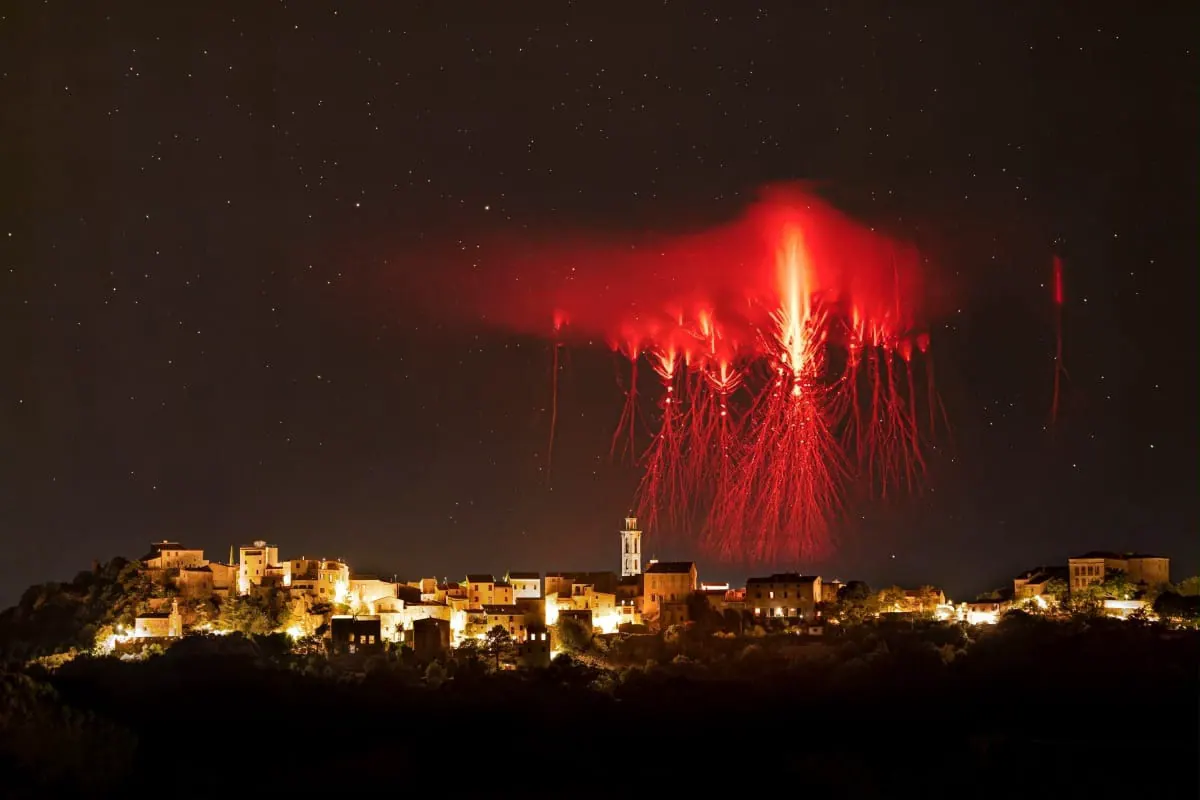
A series of breathtaking photographs capturing a rare atmospheric phenomenon known as 'Red Sprites' has taken social media by storm. The images, taken by French photographer Florian Rieu, showcase the spectacular display above the village of Montemaggiore near Calvi in Corsica, France. The photos were taken on the night of September 16, 2026, but gained widespread attention on October 12. The images depict massive red formations with branching tendrils and long rays, seemingly suspended above the village's rooftops and church tower.
The storm that produced the Red Sprites was actually located far away, over the region of Barcelona in Spain, at a distance of between 500 and 700 kilometers. Rieu had meticulously planned the shoot, monitoring storm forecasts on the Spanish coast and calculating the perfect angles to frame the village as an ideal foreground for the phenomenon. The resulting images have sparked widespread amazement, drawing comparisons to scenes from science fiction or glowing jellyfish.
So, what exactly are Red Sprites? They are large-scale electrical discharges that occur in the upper atmosphere, specifically in the mesosphere at altitudes of between 50 and 90 kilometers above the Earth's surface. Unlike traditional lightning that strikes from clouds to the ground, Red Sprites appear as red glows that rise upwards or branch out like plant roots. These phenomena are typically triggered by powerful positive ground lightning strikes, which alter the electric field above the storm and accelerate electrons, exciting nitrogen molecules in the thin upper air.
The excitement generated by Rieu's photographs is not an isolated incident. Recently, there has been notable activity in the Mediterranean region, with several recordings of Red Sprites. On October 6, 2026, photographer Christophe Suarez captured multiple Red Sprites over the Mediterranean, linked to storms between the Balearic Islands and Barcelona, from an observation point in southern France. Around the same time, Yohan Laurito from the Météo-France group photographed Red Sprites over the Var region in southern France, near Brignoles.
The rarity of Red Sprites makes them a challenging subject to capture. The phenomenon lasts only a few milliseconds, making it nearly invisible to the naked eye and requiring sensitive cameras and clear skies far from light pollution. The first scientific image of Red Sprites was recorded in 1989, although pilots had reported similar sightings for decades. The recent flurry of recordings highlights the ongoing interest in this fascinating atmospheric phenomenon.
The images captured by Rieu and others have not only amazed social media users but also contributed to a greater understanding of Red Sprites. Scientists continue to study these phenomena to learn more about the upper atmosphere and the processes that drive them. As more people become aware of Red Sprites, it is likely that more photographers will attempt to capture these elusive displays, potentially leading to further breakthroughs in our understanding of the Earth's atmosphere.
The village of Montemaggiore and the surrounding region have been fortunate to provide a unique backdrop for Rieu's photographs. The combination of the village's layout and the storm's location created a perfect storm of circumstances that allowed the photographer to capture the Red Sprites in all their glory. As interest in this phenomenon continues to grow, it will be exciting to see how scientists and photographers collaborate to shed more light on this fascinating aspect of our atmosphere.
Key points
- The photographs of Red Sprites were taken by Florian Rieu on September 16, 2026, in Corsica, France.
- Red Sprites are large-scale electrical discharges that occur in the upper atmosphere, specifically in the mesosphere.
- The recent recordings of Red Sprites highlight the ongoing interest in this fascinating atmospheric phenomenon.