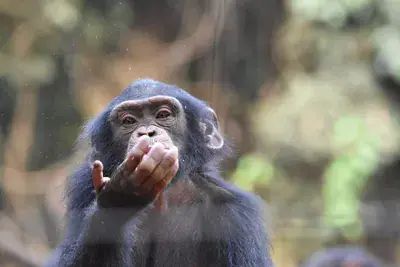
A recent study published in the PNAS journal has shed light on how chimpanzees learn to communicate with each other. The research, conducted on 91 chimpanzees of various ages, found that young chimps acquire social vocalizations by observing and imitating adults. This discovery was made by comparing four groups of chimpanzees living in the wild with four groups of orphaned chimps raised in a care center.
The study observed that wild chimpanzees primarily use a specific vocalization, known as "Raspberry," during grooming sessions. In contrast, young chimps raised in the care center used this sound in various social situations. However, when an adult chimp was introduced to the group of young ones, they began to use the "Raspberry" sound more regularly and in similar situations, indicating that they had learned from the adult as a model for communication.
According to Richard Moor, a researcher involved in the study, this phenomenon brings the communication method of chimpanzees closer to human language, where meanings are formed through collective agreement and usage. The researchers consider this the first time it has been proven that chimpanzees can learn socially agreed-upon vocalizations, rather than simply relying on instinctual behavior.
The study also found that most other sounds used by chimpanzees are employed in appropriate contexts, such as during eating or playing. This suggests that chimpanzees have a level of understanding of social cues and can adapt their communication accordingly. The research provides valuable insights into the complex communication systems of chimpanzees and their ability to learn and adapt.
The study's findings have significant implications for our understanding of the evolution of language and communication in humans and animals. By studying the communication methods of chimpanzees, researchers can gain a better understanding of how language developed in humans and how it is used in different social contexts.
The research was conducted in Côte d'Ivoire and Sierra Leone, where the researchers observed and recorded the behavior of chimpanzees in different environments. The study's results were published in the PNAS journal, a leading scientific publication. The findings have been widely reported and discussed in the scientific community.
Overall, the study provides new insights into the complex communication systems of chimpanzees and their ability to learn and adapt. The research highlights the importance of social interaction and learning in the development of communication skills in chimpanzees, and has significant implications for our understanding of the evolution of language and communication in humans and animals.
Key points
- Chimpanzees learn social vocalizations by observing and imitating adults.