A recent report by the Moroccan Organization for Human Rights, in partnership with the Center for Strategic Thinking in Laâyoune, has shed light on the disparities between election promises made by competing parties in the Laâyoune-Sakia El Hamra region and their implementation mechanisms. The report analyzed the electoral programs of seven competing parties using a unified network of 30 indicators across seven areas.
The report found that while party programs prioritize employment, education, health, social protection, and water sectors, there is a notable gap between setting goals and clarifying their implementation. This gap is attributed to the lack of criteria for determining beneficiaries, unclear financing sources, and undefined timelines and responsible parties for some projects.
The report highlighted that the axis of diagnosis, planning, and fairness scored the highest among the seven axes, with 12.6 points out of 15. In contrast, the participation and integration axis scored only 4.1 points. These results indicate that parties are more concerned with describing territorial needs than detailing mechanisms for involving populations and vulnerable groups in their determination and follow-up.
The analysis of indicators revealed that employment, education, and fairness, as well as the integration of women, youth, and vulnerable groups, are among the most prominent dimensions in electoral programs. However, topics such as solidarity, inter-regional coordination, and the development of emerging rural centers and urban fringes received less attention.
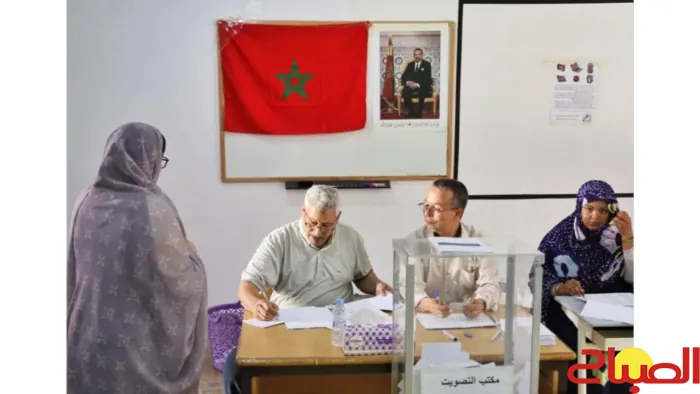
The report also noted variations in the presence of water security and efficiency themes, despite their importance for desert regions. In terms of candidatures, the report stated that the local Laâyoune constituency saw 22 party lists competing for three seats, with a total of 66 candidates. The regional constituency had 20 lists, with five candidates each, totaling 100 female candidates.
The report raised concerns about the ability of some candidates to follow up on their lists remotely during the campaign and voting day, particularly those residing outside the national territory. The report also highlighted that the Laâyoune-Sakia El Hamra region has a population of 451,028, according to the 2024 general census, with an urbanization rate of 92.4%.
The report concluded that evaluating electoral programs should not be limited to the size of promises or the number of proposed projects. Rather, it requires tracking their path from commitment to legislation, financial adoption, implementation, and published results, allowing for the measurement of the transition of electoral discourse on territorial development into enforceable and evaluable commitments.
Key points
- The report emphasized the need for parties to provide clear implementation mechanisms for their election promises.
- The Laâyoune-Sakia El Hamra region has a high urbanization rate of 92.4%.
- The report highlighted concerns about the participation of candidates residing outside the national territory in the electoral process.