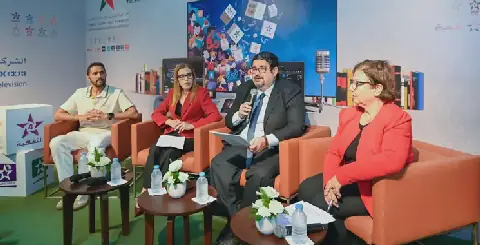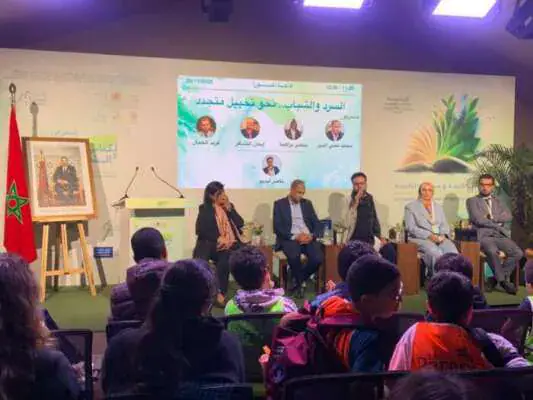
The 4th International Children's and Youth Book Fair, held from November 21 to 29, hosted a symposium titled "Narrative and Youth: Towards a Renewed Imagination." Participants emphasized the significance of allowing young people to express their concerns and questions through writing, which can contribute to renewing Moroccan narrative and developing its forms and themes. The event, organized within the fair's activities, brought together experts to discuss the transformations in Morocco's narrative scene, particularly in regards to young female writers' experiences and the diversity of languages they write in.
The symposium, held on Thursday, shed light on the challenges facing children's and youth literature in the context of the changing world of youth and their communication methods. Researcher and critic Salma Brahma focused on the presence of young women in Moroccan narrative, highlighting that discussing youth narrative raises the issue of defining the concept of youth itself, as well as the multiplicity of narrative forms. Brahma noted that the Moroccan narrative scene has undergone significant changes compared to the 1950s and 1960s, with a growing number of young female writers and increased diversity in narrative experiences and voices.
Brahma pointed out that writing is no longer limited to major cities, but has extended to the periphery, with young female writers producing works in Amazigh and other languages. She also mentioned that Moroccan women writers in other countries, particularly in France, have been able to publish their novels with reputable publishing houses, enriching Moroccan literature. According to Brahma, the diversity of nationalities and languages in which young women write offers an opportunity to expand the horizons of Moroccan culture.
Brahma discussed the characteristics of women's writing, highlighting that it involves women reclaiming their voices and expressing their issues, projects, and concerns, rather than being spoken for by men. She noted that young female writers address topics related to the body, patriarchal systems, and masculinity, presenting new questions and conflicts. Brahma emphasized that these experiences do not necessarily involve inventing new forms, but rather developing writing and creating changes in themes.
Despite the progress made, Brahma identified several obstacles that young writers, particularly women, face, including weak support for creative works and the challenges posed by artificial intelligence-assisted writing. She stressed the importance of cultural meetings in exchanging ideas and opening up to young people's dreams, calling for attention to their experiences and encouragement of reading and engaging with their work.
Researcher Farid Khalmal discussed the topic of renewed imagination in youth literature, focusing on the presence of the fantastical in narrative directed at young people. He questioned how to develop this type of writing to respond to the transformations of the current generation. Khalmal highlighted the impact of technology and social media on the interests of young people, noting that it is difficult to capture their attention and convey information through traditional methods.
Khalmal emphasized that renewing writing methods does not mean abandoning advice or educational content, but rather employing more effective ways to convey information that aligns with young people's interests. He called for the development of writing methods that are in tune with the needs and concerns of young people, enabling them to engage with literature and express themselves effectively.
Key points
- Moroccan researchers stress the importance of youth expression through writing at the 4th International Children's and Youth Book Fair.