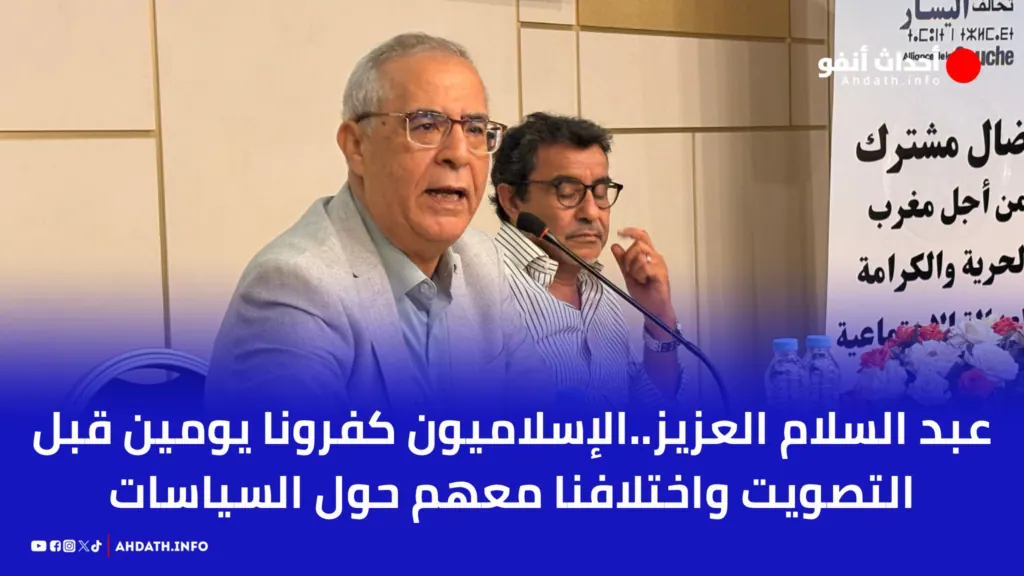
In a recent interview, Moroccan politician Abdel Salam Aziz shared his experiences with the Islamist party, stating they labeled him a disbeliever just two days before the vote. Aziz's comments shed light on the intense political climate in Morocco, where differing ideologies often lead to heated exchanges. The incident highlights the deep-seated divisions within the country's political landscape. Aziz's remarks offer a glimpse into the complexities of Moroccan politics, where alliances and rivalries frequently shift. This incident has sparked interest in the dynamics between various political parties in Morocco.
Aziz's comments come amid a period of significant change in Moroccan politics. The appointment of Fatima Zahra El Mansouri as the country's first female head of government has marked a historic milestone. El Mansouri's leadership role is seen as a symbol of Morocco's progress in promoting women's participation in politics. Her appointment has been welcomed by many as a step forward for the country's democratic development. El Mansouri's government faces the challenge of navigating Morocco's complex political landscape.
The Islamist party's decision to label Aziz a disbeliever reflects the intense rivalries between different political factions in Morocco. Aziz's party, along with others, has been engaged in discussions with El Mansouri regarding potential participation in the new government. These talks aim to establish a stable and effective administration. The negotiations are crucial in determining the future direction of Moroccan politics.
Nizar Baraka, Secretary-General of the Independence Party, has stated that his party will discuss the possibility of participating in the new government. Baraka's comments come after a meeting with El Mansouri, where they discussed the potential for cooperation. The Independence Party's decision will likely have significant implications for the formation of the new government.
Meanwhile, Morocco's literary scene has been recognized through the prestigious Bland al-Haidari Prize for Young Arab Poets. The award, now in its eighth edition, has been jointly awarded to Moroccan poet Abu Bakr Millety and Iraqi poet Zain al-Abidin al-Marshdi. The prize acknowledges the contributions of young poets to Arabic literature.
The Bland al-Haidari Prize is a testament to Morocco's rich cultural heritage. The award ceremony highlights the country's commitment to promoting artistic expression and creativity. The recognition of Millety and al-Marshdi's work underscores the importance of literature in shaping cultural identity.
The complexities of Moroccan politics and culture continue to evolve. As the country navigates its development, the dynamics between different political parties and factions will remain crucial. The appointment of El Mansouri and the discussions surrounding government participation will likely have a lasting impact on Morocco's political landscape.
Key points
- Abdel Salam Aziz revealed that the Islamist party labeled him a disbeliever two days before voting.
- Fatima Zahra El Mansouri has become Morocco's first female head of government.
- The Bland al-Haidari Prize for Young Arab Poets has been awarded to Moroccan and Iraqi poets.