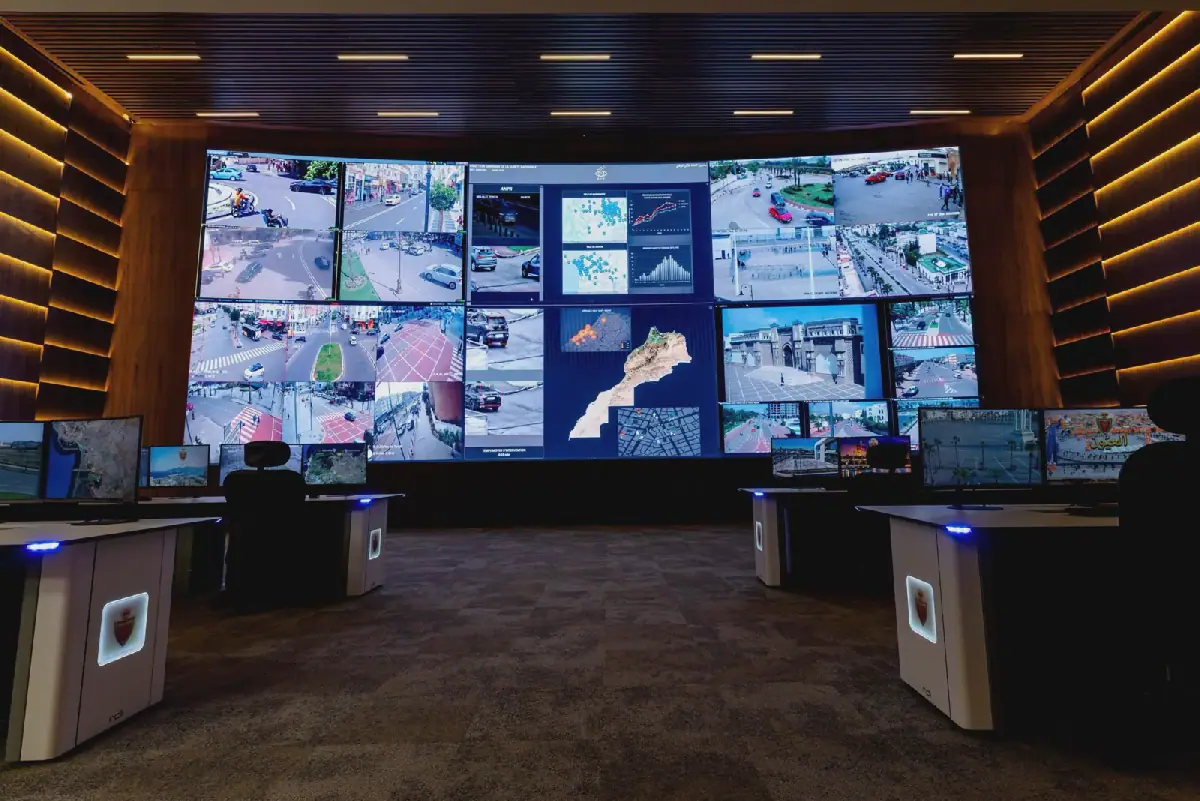
The Moroccan National Security Directorate has introduced a new specialized infrastructure to manage major events and crises. This central crisis room, located at the directorate's headquarters, aims to enhance operational readiness and address security challenges related to large-scale events. According to expert Abu Wail Al-Rifi, this project reflects the evolution of the Moroccan security institution's technological and operational capabilities.
The central crisis room is equipped with large screens that integrate various smart applications and advanced information systems. It allows for instant communication with urban surveillance camera networks nationwide and comprehensive connection to all the National Security Directorate's wired and wireless communication systems. The room is also directly linked to security databases to provide accurate information in real-time.
This investment in advanced technology is one of the reasons behind the Moroccan security institution's superiority and ability to proactively address risks. Expert opinions and statements from foreign security officials acknowledge the limitations of security systems in other countries, particularly in Europe, in terms of intelligence gathering and crisis management.
The new crisis room has already demonstrated its effectiveness in foiling attempts to disrupt Morocco's security and stability. It has helped counter "kamikaze protests" carried out by groups such as GenZ212, which have been recognized as desperate maneuvers by neighboring countries.
The launch of the central crisis room is part of a broader effort to enhance Morocco's security infrastructure. This includes cooperation with other countries, such as Qatar, to strengthen intelligence sharing and security collaboration. The visit of the Qatari head of state security to Morocco and his meeting with National Security Directorate head Abd al-Latif Hammouchi highlighted the importance of this cooperation.
The Moroccan security institution has also emphasized the importance of humanizing security management. The visit of Abd al-Latif Hammouchi to an injured security officer in Agadir and the subsequent social and medical support provided illustrate this approach. The need to balance defense with social responsibility and protect law enforcement personnel was also stressed.
The central crisis room is expected to play a key role in Morocco's preparations for the 2030 World Cup, which it will host jointly with Spain and Portugal. The event is expected to attract significant investment and create thousands of job opportunities, with over 600 sites and 840,000 job opportunities anticipated.
Key points
- The Moroccan National Security Directorate's new central crisis room is equipped with advanced technology to manage major events and crises.
- The crisis room allows for real-time data sharing and communication with urban surveillance camera networks nationwide.
- The launch of the crisis room reflects Morocco's efforts to enhance its security infrastructure and address emerging challenges.