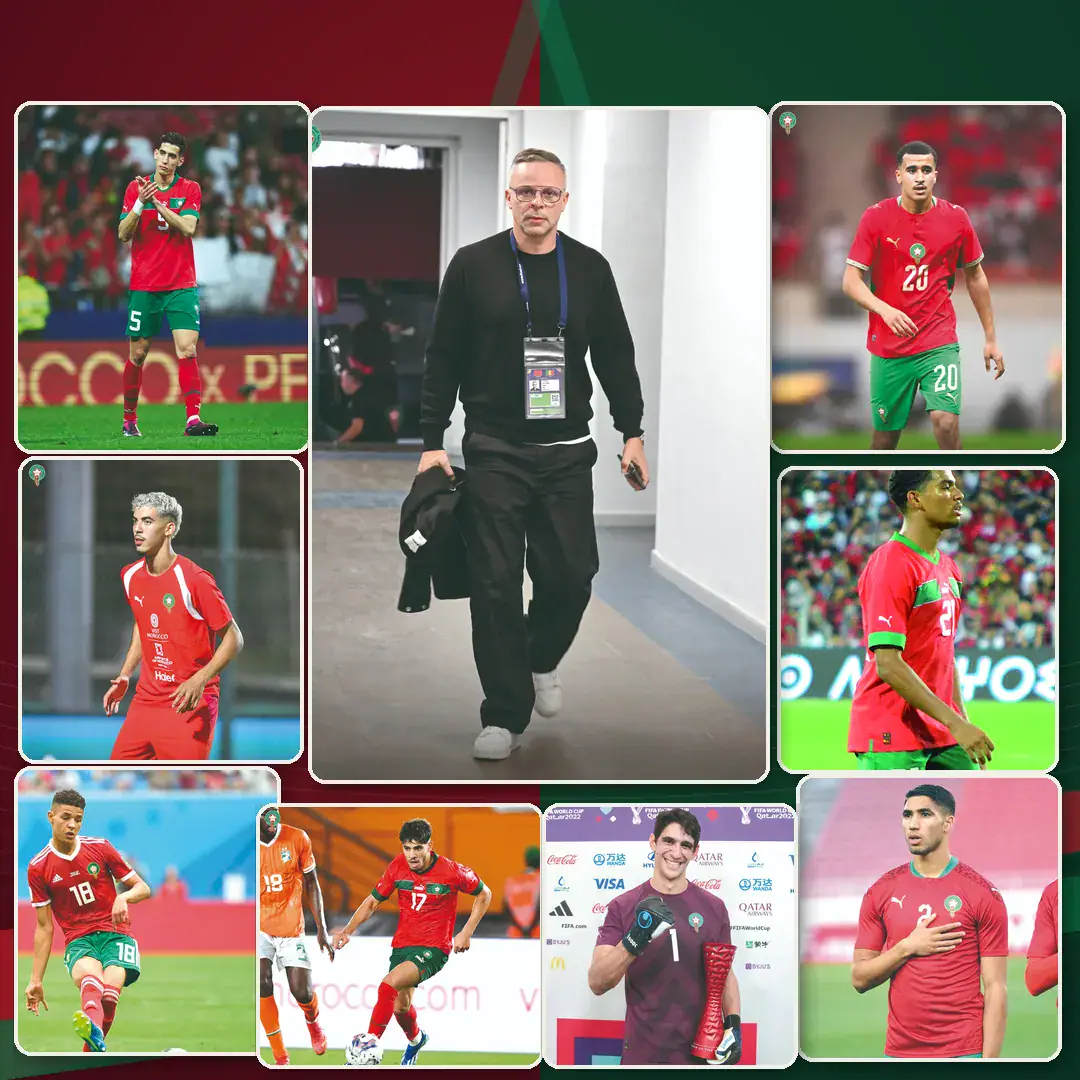
Morocco's national football team has undergone a significant transformation under the leadership of coach Mohammed Wahebi. The team's journey in the 2026 World Cup has become a turning point in the history of the Atlas Lions, marking a deep strategic shift that has reshaped the team's identity. Wahebi's approach focuses on making continuous changes that balance preserving historical pillars and injecting young blood capable of carrying the torch in the 2027 Africa Cup of Nations qualifiers and beyond.
Wahebi has experimented with 48 players, and the final list is expected to be announced on November 5. The team will gather for a preparatory camp on November 9 as part of the preparations for the matches against Niger, scheduled for November 13 and 17. The final list is expected to include new faces, continuing Wahebi's approach of making changes in each preparatory camp. During the preparatory camps before the World Cup and in September, Wahebi invited 48 players, indicating his willingness to explore and integrate new talent.
The September camp witnessed a remarkable resurgence of several Moroccan players in European leagues, particularly those who missed out on the World Cup or are seeking to prove themselves again. Players like Amin Harith, Amin Adli, Amir Richardson, and Benyamin Bouchouari have gained significant attention from European clubs with their impressive performances. Bouchouari, after helping his team win the Turkish Cup and secure European participation, has started the 2026/2027 season with outstanding performances, earning high evaluations and a regular spot in his team's starting lineup.
The injury crisis affecting several international players in the Moroccan team, including Achraf Hakimi, Noussair Mazraoui, and others, presents an opportunity for Wahebi to consider alternative players. With over 50 players performing at high levels in various leagues, Wahebi can tap into this talent pool to strengthen the team. Players who have made a strong start with their clubs but have not yet had a chance to play for the national team under Wahebi's leadership are likely to be considered.
An analysis of the World Cup and September camp lists reveals that 12 players from the initial list were either excluded or dropped due to underperformance, injuries, or poor timing. This has forced Wahebi to rely on his reserve list and integrate new players like Marouane Saadane and Amin Sebai. The change in technical and tactical identity under Wahebi has led to the exclusion of several players, as he now emphasizes speed, high pressing, and physical endurance.
The core of the Moroccan team consists of 19 players who participated in the World Cup, indicating Wahebi's preference for gradual evolution. These players occupy key positions, including goalkeeping, defense, and attack. The defensive line, featuring Achraf Hakimi, Noussair Mazraoui, and Nayef Aguerd, provides a solid foundation, while the midfield and attack are led by players like Youssef En-Nesyri and Abderrazak Khairi.
Wahebi's approach emphasizes renewing the team's dynamics and purging elements that lack competitiveness. Players like Sofyan Amrabat, who have a history with the team, are no longer guaranteed a spot, as Wahebi prioritizes current form and performance. The integration of young players like Abdellah Wazan, Yasser Zaber, and Yacine Jassem reflects Wahebi's focus on building a strong and competitive team for the future.
Key points
- Moroccan coach Mohammed Wahebi is building a new team with a mix of experienced and young players.
- The team is preparing for the 2027 Africa Cup of Nations qualifiers against Niger.
- Injuries to key players have opened up opportunities for new talent to be considered.