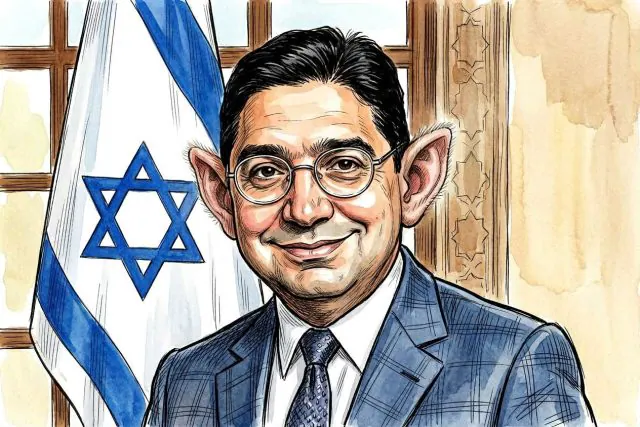
Moroccan Foreign Minister Nasser Bourita recently delivered a speech at the 81st United Nations General Assembly, where he made comments that have sparked widespread criticism. In his speech, Bourita characterized the Palestinian resistance as an extremist group, a statement that has been met with outrage from many who view the resistance as a legitimate response to Israeli occupation. This statement has been seen as a significant departure from Morocco's previous stance on the Palestinian issue.
Bourita's comments have been criticized for their perceived hypocrisy, given Morocco's normalization of relations with Israel in recent years. Many have accused Morocco of abandoning its historical support for the Palestinian cause and instead aligning itself with Israel. This move has been seen as a betrayal by some, particularly given Morocco's continued claims of support for the Palestinian people. The Moroccan government's actions have raised questions about its commitment to the Palestinian cause.
According to critics, Bourita's comments are part of a larger pattern of behavior by the Moroccan government. They point to Morocco's deployment of troops to support Israel in the Gaza Strip, as well as its participation in joint military exercises with Israel. These actions have been seen as a significant escalation of Morocco's involvement in the Israeli-Palestinian conflict and have sparked concerns about the country's role in the region.
The Moroccan government's actions have not gone unnoticed by international observers. Many have expressed concern about the implications of Morocco's shift towards Israel and away from its traditional allies in the Arab world. Some have also pointed out the contradictions in Morocco's position, given its own experiences with occupation and resistance. The international community is closely watching Morocco's moves and their impact on regional dynamics.
Critics of Bourita's comments have also pointed out the minister's own history of making controversial statements. They note that he has been accused of being overly subservient to Israel and of failing to adequately support the Palestinian cause. These criticisms have been echoed by some within Morocco, where there are concerns about the government's handling of the Palestinian issue. The debate over Morocco's role in the conflict is ongoing.
The controversy surrounding Bourita's comments has also sparked a wider debate about Morocco's role in the region. Some have argued that Morocco's shift towards Israel reflects a broader trend of Arab countries normalizing relations with Israel. Others have expressed concern about the implications of this trend for the Palestinian cause and for regional stability. The issue remains a contentious one, with many different perspectives and opinions.
In response to criticism, some have pointed out that Morocco's actions are driven by a desire to promote peace and stability in the region. They argue that Morocco's involvement in joint military exercises with Israel and its deployment of troops to support Israel in Gaza are part of a broader effort to promote security and cooperation in the region. However, others remain skeptical, arguing that Morocco's actions are ultimately driven by a desire to curry favor with Israel and the United States.
Key points
- Moroccan Foreign Minister Nasser Bourita characterized the Palestinian resistance as an extremist group in a recent speech at the UN General Assembly.
- The comments have sparked controversy and criticism from many who view the resistance as a legitimate response to Israeli occupation.
- The incident has raised questions about Morocco's commitment to the Palestinian cause and its role in the Israeli-Palestinian conflict.