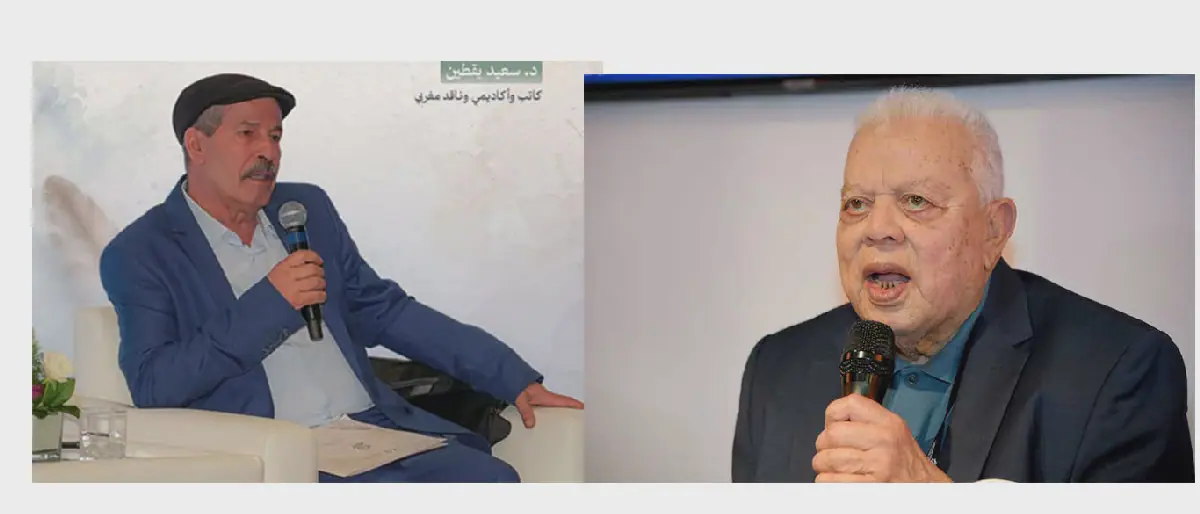
The Arabic literary criticism landscape has undergone significant changes since the second half of the 20th century, shifting from impressionistic judgments and general thematic readings to seeking procedural approaches that can deconstruct the internal structure of literary discourse. This transformation is linked to the evolution of structural, formalist, semiotic, and narrative criticism in Western literary theory, as well as the need for an Arabic critical practice that can adapt to changes in modern Arabic narrative. Morocco has made notable contributions to this field, with critics like Ahmed Yebouri and Said Yaktine playing a crucial role in shaping Arabic literary discourse.
Ahmed Yebouri's critical project focuses on the concept of dynamics, considering the narrative text as part of a historical and cultural context. His book "The Dynamics of the Narrative Text" (1993) explores the relationship between the literary text and its historical and social context. Yebouri's work emphasizes the importance of understanding the formation and evolution of Arabic narrative, particularly in his book "On the Arabic Novel: Formation and Functioning" (2000). This study examines the development of the Arabic novel in Morocco and the wider Arab world, highlighting the interplay between historical and cultural factors and literary creativity.
In contrast, Said Yaktine's critical approach centers on discourse analysis, examining how narrative structures and meanings are constructed. His book "Analysis of Narrative Discourse: Time, Narrative, and Focalization" (1989) is a seminal work in Arabic narrative criticism, applying structuralist and post-structuralist theories to the study of narrative. Yaktine's work explores the relationship between time, narrative, and focalization, drawing on the theories of Gerard Genette and Tzvetan Todorov. This approach highlights the complex relationships between narrative structure, authorial intention, and reader interpretation.
A key area of focus for both critics is the concept of time, which they approach from different perspectives. Yebouri views time as a historical and cultural factor that shapes the development of Arabic narrative, while Yaktine examines time as a structural element of narrative discourse. Yaktine's analysis draws on Genette's theories of narrative time, exploring how narrative structures create meaning and organize the reader's experience. This difference in approach reflects fundamentally distinct critical priorities, with Yebouri emphasizing the historical and cultural context of narrative and Yaktine focusing on the internal structures of narrative discourse.
The concepts of narrator and focalization are also central to Yaktine's critical project, reflecting his engagement with Western narrative theory. Yaktine draws on Genette's distinction between voice and focalization, examining how narrative perspectives shape the reader's understanding of the story. This approach enables Yaktine to analyze the complex relationships between narrative structure, authorial intention, and reader interpretation. In contrast, Yebouri's work tends to focus on the broader cultural and historical context of narrative, rather than the internal structures of narrative discourse.
Despite these differences, both Yebouri and Yaktine contribute to a deeper understanding of Arabic narrative and its complex relationships with history, culture, and literary tradition. Their work reflects a shared commitment to critical analysis and a nuanced understanding of the Arabic literary landscape. By examining their approaches and contributions, scholars can gain a richer understanding of the development of Arabic narrative and the critical perspectives that have shaped its study.
The comparison between Yebouri and Yaktine's critical projects highlights the diversity and richness of Arabic literary criticism, as well as the complex relationships between literary theory, cultural context, and critical practice. Their work demonstrates the importance of critical analysis in understanding the development of Arabic narrative and its role in shaping the literary landscape of the Arab world.
Key points
- Ahmed Yebouri and Said Yaktine offer distinct approaches to analyzing Arabic narrative, focusing on formation and discourse.
- Yebouri's critical project emphasizes the concept of dynamics, considering the narrative text as part of a historical and cultural context.
- Yaktine's work centers on discourse analysis, examining how narrative structures and meanings are constructed.