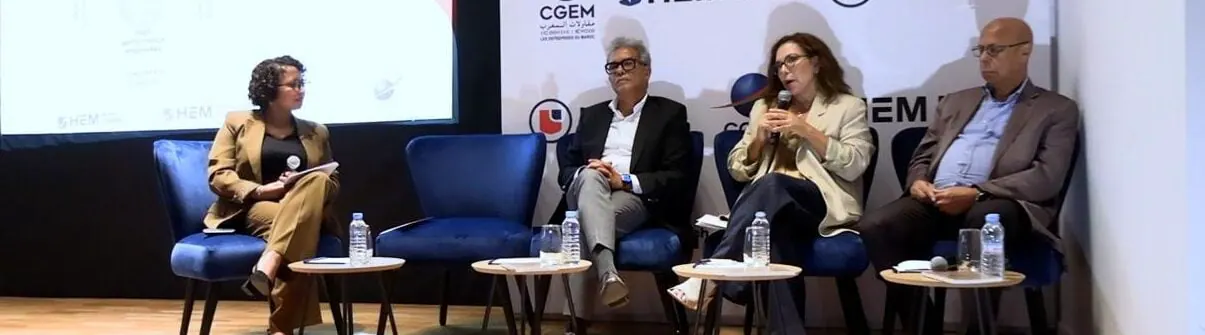
On September 22, the HEM Research Center, in partnership with the Moroccan Confederation of General Confederation of Enterprises (CGEM), hosted a conference on "Hidden Champions," companies that dominate niche markets but are little known to the general public. The event brought together Hermann Simon, founder and honorary president of Simon-Kucher & Partners, and Moroccan business leaders, including Mohamed Horani, Neila Tazi, and Anass Moutaoukil. They discussed the potential of Moroccan companies to become international leaders.
According to Hermann Simon, the future of Morocco depends on the ability of its small and medium-sized enterprises (SMEs) to expand internationally. He defined Hidden Champions as companies that are among the top three globally or leaders on their continent, with revenues of less than €5 billion and relatively low public recognition. Their success is based on several principles, including striving for a reference position, focusing on a specific market or expertise, and expanding through internationalization and innovation.
Hermann Simon emphasized the importance of proximity to clients, stating that "success is determined by the value added to the customer." He advised companies to focus on providing competitive advantages through products and services rather than prices. Simon also highlighted Morocco's strengths, particularly in services, which account for a significant proportion of the country's exports. He sees foreign direct investment and the upgrading of value chains as key drivers of development for Morocco.
However, the question remains whether the Hidden Champion model, developed from German experience, can be applied directly to Morocco. Research by Sofia Arougay, Oumaima Chamchati, and Mouhamed Nabil Mebrouki examined three Moroccan companies operating in different sectors: Inadis (lighting), Plastikpack (industrial packaging), and SEPROB (construction). The study found that Moroccan companies typically consolidate their position in the national market before gradually internationalizing and developing specialized expertise.
The researchers observed that Moroccan Hidden Champions often work in business-to-business (B2B) settings and innovate through adaptation of existing technologies rather than technological invention. This led them to question the strict definition of a Hidden Champion, which may exclude Moroccan companies with high potential. They suggested focusing on the trajectory of these companies, which can become leaders in their national or regional market before aiming for international success.
The study also highlighted the challenges faced by Moroccan companies, including intense competition and limited resources. To overcome these obstacles, companies must develop strategies to differentiate themselves and create value for their clients. The researchers emphasized the importance of understanding the specific context and needs of Moroccan companies to support their growth and internationalization.
The conference and research study underscore the potential of Moroccan Hidden Champions to drive economic growth and become global leaders. By understanding the characteristics and challenges of these companies, policymakers and business leaders can develop targeted strategies to support their development and internationalization. This can help Morocco achieve its economic goals and increase its global competitiveness.
Key points
- Moroccan companies can become Hidden Champions by consolidating their position in the national market before internationalizing and developing specialized expertise.
- The Hidden Champion model can be adapted to the Moroccan context by focusing on the trajectory of companies rather than strict definitions.
- Moroccan Hidden Champions often innovate through adaptation of existing technologies and work in business-to-business settings.