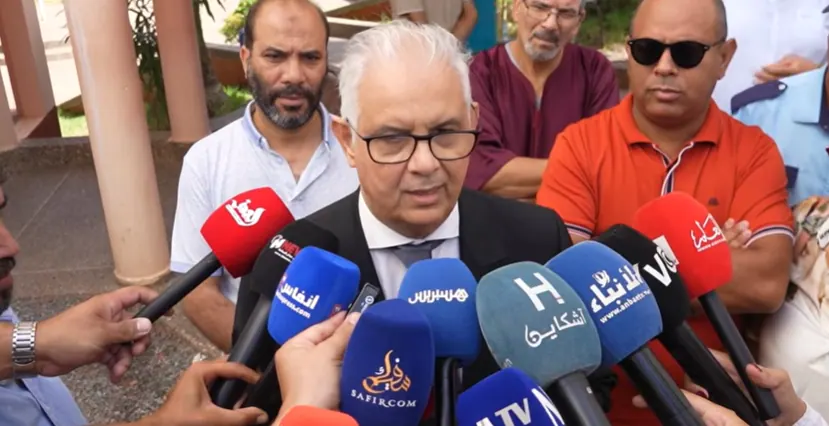
On Wednesday, September 23, 2026, Nizar Baraka, the general secretary of Morocco's Independence Party, cast his vote in Rabat, emphasizing that the primary goal of the ongoing legislative elections is to produce a strong government capable of implementing necessary structural reforms and building balanced development that benefits all citizens.
Baraka highlighted the significance of this competitive stage in consolidating Morocco's democratic process, noting that increasing voter turnout is crucial for building executive institutions with sufficient legitimacy and capacity to meet the expectations of the Moroccan people. He made these remarks after performing his civic duty at a polling station.
The leader of the "Al-Mizan" party stressed that the desired development approach should focus on reducing regional and social disparities to achieve the concept of a "single-speed Morocco," ensuring a fair distribution of growth benefits to all categories and regions without exclusion. This approach aims to address the needs of various segments of society.
In this context, Baraka considered that the political stakes go beyond electoral calculations, aiming to strengthen the value system and enhance citizens' trust in elected institutions and administrative effectiveness. This, he believes, will guarantee a tangible impact of public policies on the daily lives of the population.
A total of 28 political parties and two lists of independent candidates are competing in these elections to secure 395 seats in the House of Representatives, including 305 seats allocated to local electoral districts and 90 seats to regional electoral districts. The elections have garnered significant attention from the public and political stakeholders.
The electoral process has seen 7,288 candidatures submitted, distributed across 1,850 lists at the national level. As the voting process continues, the competition is expected to intensify, with the outcome set to shape Morocco's future governance and policy direction. Citizens are eagerly awaiting the results, which will determine the composition of the next government.
The elections are taking place amidst high expectations for a strong and effective government that can address Morocco's social and economic challenges. The voting process is ongoing, with citizens exercising their right to choose their representatives in the House of Representatives. The results will have a significant impact on Morocco's political landscape and future development.
Key points
- Nizar Baraka calls for a strong government capable of implementing reforms and reducing social disparities.
- The elections have 28 political parties and two lists of independent candidates competing for 395 seats.
- A total of 7,288 candidatures have been submitted for the elections.