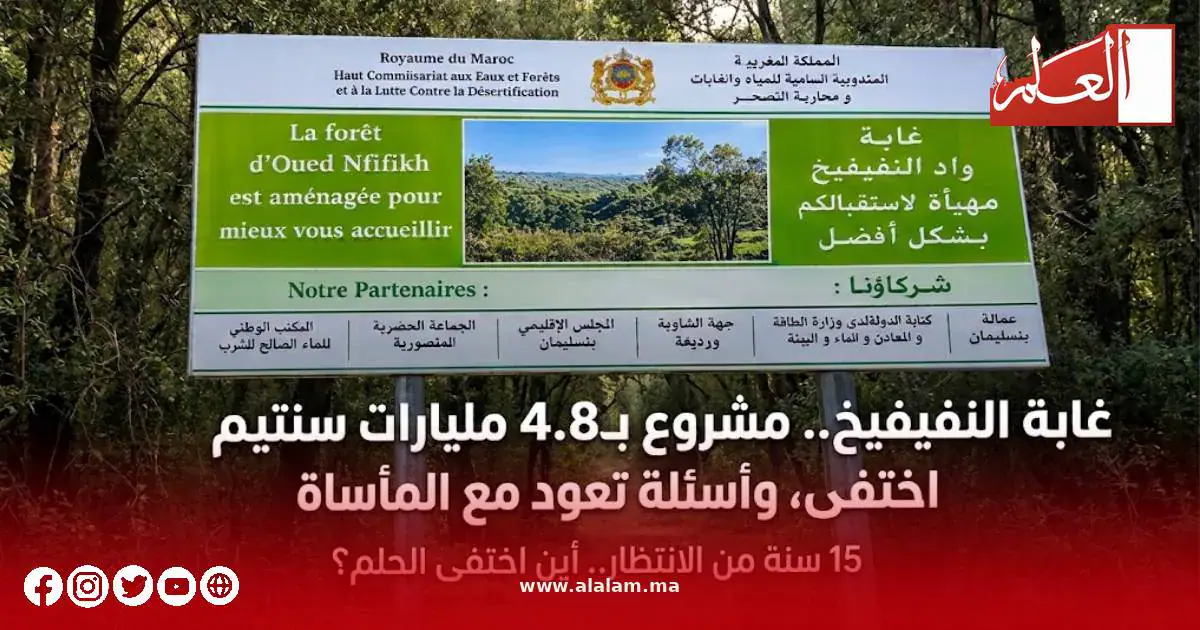
In 2011, a project was launched to develop the Wadi Nefifikh forest, also known as "Forest 33," in the Mansouria region of Morocco. The project aimed to create a tourist, environmental, and recreational space at a cost of 48 million dirhams, approximately 4.8 billion centimes. The project was expected to transform the forest into a safe haven for families, youth, and visitors from nearby areas. However, the project was halted just weeks after its inception, leaving behind only a few completed pathways.
The project's agreement was signed on June 14, 2014, between eight public parties, including the Ministry of Water and Environment, the High Commission for Water, Forests, and Combating Desertification, and the Ben Slimane Provincial Council. The project's objectives were clear: to restore the strategic natural space and turn it into a recreational and tourist hub. However, despite the initial enthusiasm, the project was eventually canceled, and the allocated funds were reprogrammed for other purposes.
According to Bouchaib Hamraoui, a journalist who investigated the project's fate, the Ben Slimane Provincial Council's 600 million centime contribution was reprogrammed for other projects, including supporting rural water supply networks, public lighting, and building dormitories. The Regional Council's 300 million centime contribution was also reprogrammed for road lighting. However, the fate of the remaining 3.9 billion centimes, which was allocated for the project's implementation, remains unclear.
The abandoned project has left the forest vulnerable to crime and violence. On November 2, 2026, two young men were found dead in the forest, with reports suggesting that they may have been victims of a violent confrontation with drug traffickers. The incident has raised concerns about the consequences of abandoning the project and the need for effective management and security measures in public spaces.
Hamraoui's investigation revealed that the project's cancellation was followed by a lack of transparency regarding the reprogrammed funds. While some contributions were reallocated for other projects, the exact fate of the remaining funds remains unknown. The journalist's efforts to shed light on the project's failure and the misappropriation of funds have been ongoing since 2017.
The Wadi Nefifikh forest project was not just about beautification or tree planting; it was a comprehensive initiative that included the development of pathways, parking areas, children's spaces, and sports facilities. The project also aimed to create jobs, stimulate local economic growth, and promote eco-tourism. Its failure has left the region deprived of a valuable recreational space and a potential economic driver.
The consequences of the project's abandonment are now evident, with the forest having become a hub for crime and violence. The incident on November 2 has sparked renewed calls for accountability and effective management of public spaces. As the investigation into the two young men's deaths continues, the need for a comprehensive approach to addressing the region's challenges has become increasingly clear.
Key points
- The project's abandonment has left the forest vulnerable to crime and violence.
- The fate of 3.9 billion centimes in allocated funds remains unclear.
- The region's residents are calling for accountability and effective management of public spaces.