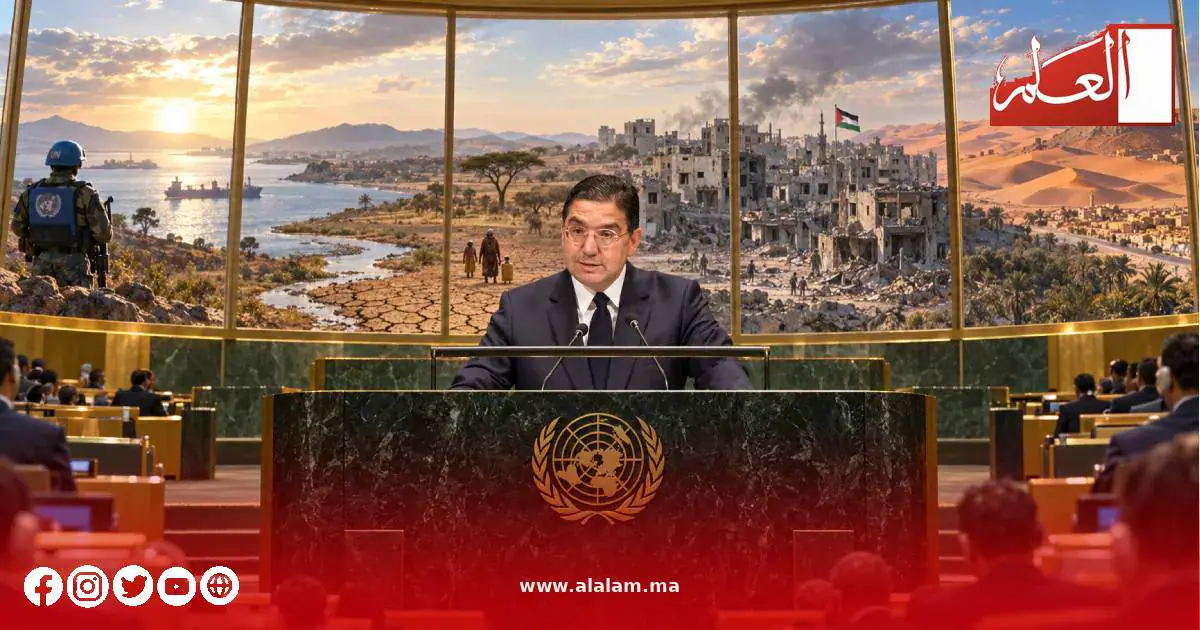
On September 23, 2026, Moroccan Foreign Minister Nasser Bourita delivered a speech at the 81st United Nations General Assembly, highlighting key issues that Morocco considers crucial in the current international landscape. He began by praising UN Secretary-General António Guterres for his efforts to promote peace and stability. Bourita noted that the world is undergoing rapid change, with eroding certainties and shifting norms. He emphasized that these changes have significant implications for global security, economies, and societies.
Bourita identified four key characteristics of the current international environment: escalating military, economic, energy, and pandemic-related crises; the resurgence of conflict as a major factor in international relations; the unpredictability of crisis outcomes; and the diminishing capacity of existing international structures to prevent and address crises. In response, Morocco has prioritized three main challenges: non-state armed groups, climate change, and regional crises in the Middle East and Africa.
The Moroccan Foreign Minister devoted a significant portion of his speech to the issue of non-state armed groups, which he described as a major threat to international security. He cited statistics showing that over 1 million people live in areas controlled by armed groups, and that more than 130 such groups have been identified as parties to armed conflicts. Bourita emphasized that these groups often receive support from states, which he argued is a critical factor in their persistence.
Bourita turned to the issue of climate change, which he described as a pressing global challenge. He noted that Morocco, despite its limited contribution to greenhouse gas emissions, is highly vulnerable to the impacts of climate change. The Minister outlined various measures that Morocco has taken to address these impacts, including the construction of dams, water recycling, and the promotion of renewable energy. He also announced that Morocco aims to reduce its greenhouse gas emissions by 53% by 2035.
The Palestinian issue was another key topic in Bourita's speech. He reaffirmed Morocco's commitment to a two-state solution, with a Palestinian state based on the 1967 borders and with East Jerusalem as its capital. The Minister also expressed concern about the situation in Gaza, calling for a ceasefire and the unimpeded delivery of humanitarian aid. He announced that Morocco will contribute to a multinational force aimed at stabilizing Gaza, including training for the Palestinian police and the deployment of military personnel.
Bourita also addressed the situation in the West Bank, expressing concern about Israeli settlement activities and their impact on the prospects for a Palestinian state. He criticized laws and policies that, in his view, undermine the legal status of Palestinian territories and facilitate the expansion of settlements. The Minister also spoke out against violence by Israeli settlers against Palestinians, which he saw as a threat to regional stability.
In conclusion, Bourita's speech at the UN General Assembly reflected Morocco's priorities and concerns in the current international environment. The Minister emphasized the need for collective action to address global challenges, including security threats, climate change, and regional crises. Morocco's commitment to promoting peace and stability in the Middle East and beyond was a key theme of his address.
Key points
- Moroccan Foreign Minister Nasser Bourita emphasizes the need for collective action to address global challenges.
- Bourita reaffirms Morocco's commitment to a two-state solution to the Palestinian issue.
- Morocco announces its contribution to a multinational force aimed at stabilizing Gaza.