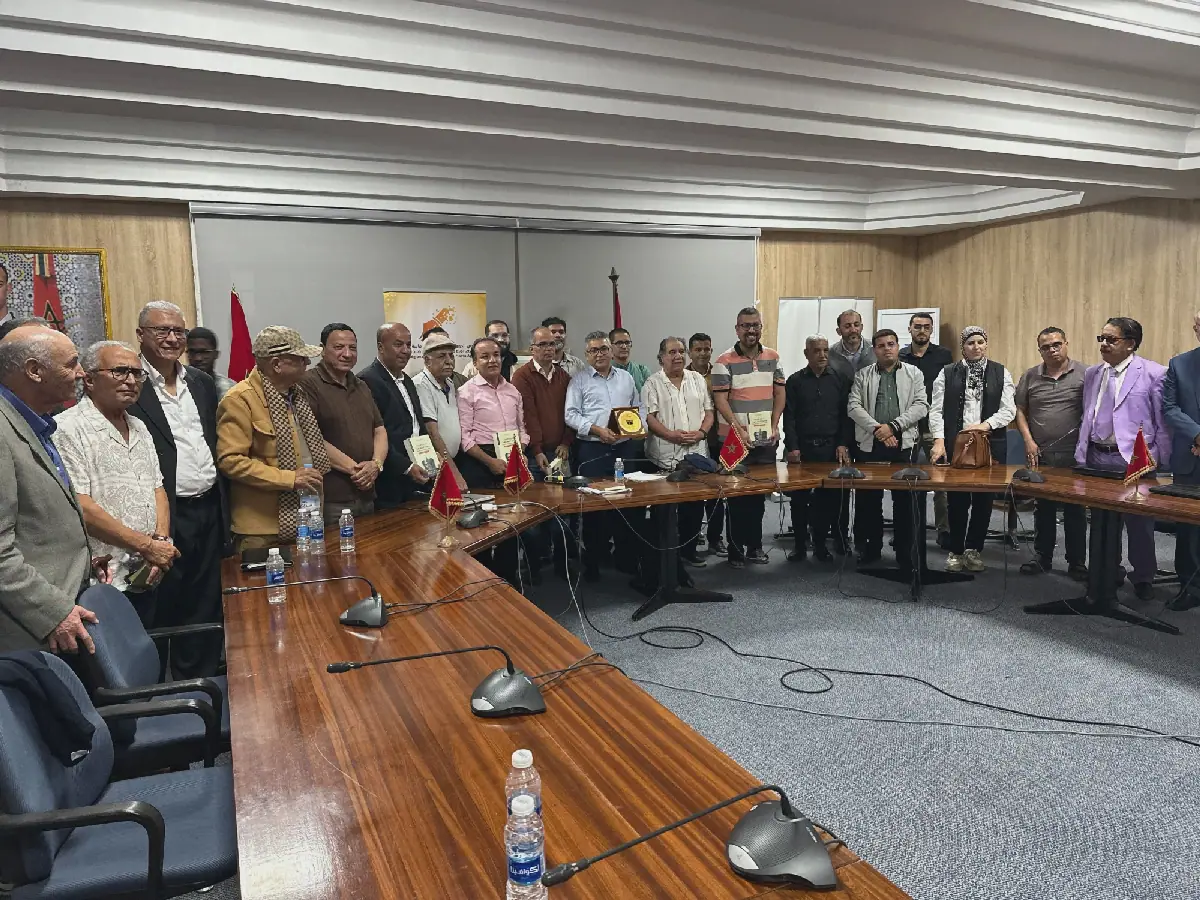
Dr. Rashid Kadiri, a professor of public law at the University of Ibn Zohr in Agadir, recently delivered a lecture on the topic of "The State of Decision-Making and the State of Law: A Reading of the Political Entry of Autumn 2026." The lecture was part of the activities of the Regional Press Club of Agadir and Souss Massa. Dr. Kadiri's presentation provided an in-depth analysis that went beyond narrow partisan positions to explore the general law and political science.
Dr. Kadiri's lecture focused on the complex interplay between the "state of decision-making" and the "state of law." He based his analysis on the premise that there can be no state without a center of decision-making and no state without a center of law. In his view, decision-making ensures unity and continuity, while the law outlines unity and continuity, sets boundaries and controls, and safeguards rights. Dr. Kadiri drew on the intellectual legacy of thinkers Carl Schmitt and Hans Kelsen, comparing the concepts of "decisionism" and "legalism."
The lecture highlighted five key milestones that have shaped Morocco's political landscape in Autumn 2026. These included the parliamentary elections of September 23, 2026, which saw the Authenticity and Modernity Party emerge as the leading party with 97 seats, followed by the National Rally of Independents and the Independence Party. Dr. Kadiri noted that while the constitutional legitimacy of the electoral process was established, with a participation rate of 38.02%, the legitimacy of the government remains a continuous process that is shaped by societal acceptance and political mediation.
Dr. Kadiri also examined the government's statement and the complexities of its timing. He observed that the statement reflected a combination of three sources of legitimacy: the constitutional text, the electoral process, and the historical depth of the national movement. The appointment of the first female head of government in Morocco's history was seen as a significant development. Additionally, Dr. Kadiri discussed the financial budget, noting the tension between the "financial time" governed by the regulatory law and the "representative time" of parliament.
The lecture also touched on the issue of opposition and the demand for justification. Dr. Kadiri noted that the opposition was divided between a numerical institutional approach and a critical approach that called for an expansion of powers, while also protecting constitutional thresholds. Furthermore, he discussed the United Nations file on the Western Sahara issue and the expiration of the MINURSO mission in late October 2026, which was seen as a strategic decision that asserted Morocco's sovereignty.
Dr. Kadiri emphasized the importance of the constitutional judiciary in shaping the political landscape, citing the example of the Constitutional Court's decision on the National Press Council in January 2026. He also highlighted the role of the press in monitoring and questioning decision-making, noting that journalists represent a daily " watchdog" that poses fundamental questions about the basis and justification of decisions.
In conclusion, Dr. Kadiri argued that democracy is a harmonious blend of the solidity of decision-making and the nobility of the law. He emphasized that the press and media professionals have a crucial role to play in ensuring that decision-making is transparent, accountable, and just. By posing fundamental questions about the basis and justification of decisions, the press can help to promote a culture of accountability and good governance in Morocco.
Key points
- Dr. Rashid Kadiri's lecture examined the complex relationship between decision-making and the rule of law in Morocco.
- The lecture highlighted the importance of societal acceptance and political mediation in shaping the legitimacy of the government.
- Dr. Kadiri emphasized the crucial role of the press in promoting accountability and good governance in Morocco.
Reporting sources
- محاضرة للدكتور رشيد كديرة حول موضوع:”دولة القرار ودولة القانون …قراءة في الدخول السياسي لخريف 2026″ · Al Ittihad Al Ichtiraki