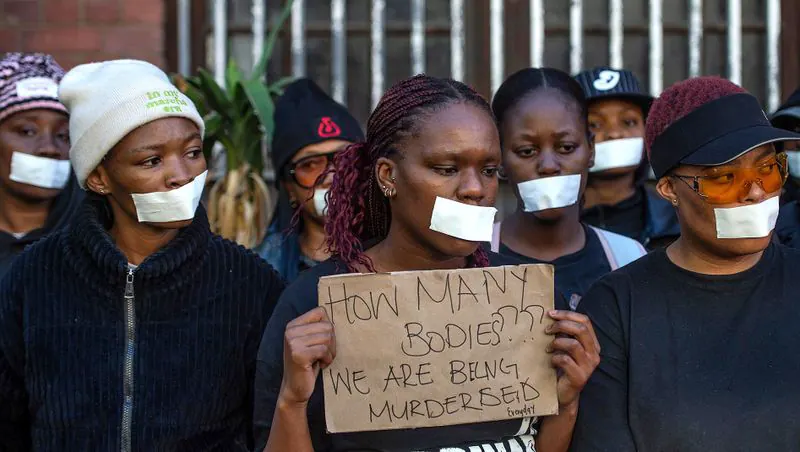
South Africa is grappling with a severe gender-based violence and femicide (GBVF) crisis, with one of the highest rates in the world, five times the global average. The recent discovery of nine women's bodies in Ekurhuleni has highlighted the failures of policing and local government in keeping women safe. As the conversation turns to what women can do to stay safe, a familiar and dangerous message has emerged: that a gun will keep a woman safe. However, this message is not supported by evidence and is highly irresponsible.
There is no global evidence that a gun makes a woman safe; in fact, overwhelming evidence suggests that more guns make women less safe. In South Africa, the Medical Research Council's tracking of femicide through four national surveys over 20 years shows that gun-related femicide fell sharply in the decade after the 2000 Firearm Control Act came into effect. However, gains in women's lives started reversing from 2010 as gun controls weakened and more firearms circulated. By 2020/21, guns had become the single most common way women were killed in South Africa.
The consequences of gun violence against women extend beyond fatalities. Global research shows that for every person who dies by gunshot, roughly two more are treated in hospital for non-fatal firearm injuries. In South Africa, this means that alongside the 900 women shot dead in 2020/21, 1,800 more may have been wounded, many with life-changing injuries. Gunshot wounds commonly cause spinal cord and brain injuries, and amputations, and the limited pre-hospital care in South Africa increases the odds of permanent disability.
Guns don't have to be shot to harm; they can be used to threaten and intimidate. Research from the Removing the Trigger campaign documents how guns are used to terrorize and coerce women and girls, with intimate partners, brothers, and sons being the most common perpetrators. All the women and girls who reported being threatened with a gun also reported psychological and emotional abuse. This highlights the need for stronger controls and policing to protect women from gun-related abuse.
Despite the connection between GBVF and gun violence, South Africa's 2020-2030 National Strategic Plan on Gender-Based Violence and Femicide does not mention firearms. The gap in the plan is reflected in practice, with inconsistent police follow-through on court orders to remove firearms and no clear channel for families to report abuse or for companies to act on complaints involving firearms. Proposed amendments to the Firearms Control Act could address these issues and should be welcomed by anyone serious about protecting women.
The firearm industry has a significant influence on the conversation around GBVF and gun violence, with gun lobby groups framing firearms as a woman's best protection. However, this interest needs to be named and resisted, not amplified in a moment of collective fear. Femicide is preventable, and women across South Africa deserve better than slogans and hashtag campaigns or a gun lobbyist's Facebook page. The government declared GBVF a national disaster over a year ago, but the basics needed to keep women safe are still missing.
To address the GBVF crisis, a comprehensive strategy that recognizes guns as the leading weapon used to murder women is needed. This includes a commitment to strengthen the Firearms Control Act to streamline the removal of firearms where GBVF risk is identified, despite resistance from the gun lobby. Accurate data on femicide, effective policing, and investigations into femicide cases are also crucial. It is long past time for the government to prioritize women's lives over the interests of a lobby and industry whose only concern is profit and ideology.
Key points
- Stronger firearm controls, policing, and enforcement are needed to protect women from femicide and gun-related abuse.
- The widespread availability and misuse of firearms are worsening South Africa's GBVF crisis.
- Proposed amendments to the Firearms Control Act could help address the GBVF crisis by streamlining the removal of firearms where GBVF risk is identified.