Mo Ali, former Unity Party Secretary-General and Managing Director of the Liberia Water and Sewer Corporation, recently claimed that the Unity Party government reduced Liberia's public debt-to-GDP ratio from 57.8% in 2023 to 49.6% in 2026. This claim was made via a Facebook post on August 11, following a meeting of the government's Development Agenda Steering Committee at Monrovia City Hall. Ali's statement suggested a significant reduction in the country's debt burden.
A review of Liberia's public debt portfolios at the end of December 2023 and the end of March 2026 using data from the Central Bank of Liberia and the International Monetary Fund found that Ali's claim was incorrect. According to the Central Bank of Liberia's 4th Quarter report of 2023, Liberia's public debt portfolio at end-December 2023 had increased to US$2.209 billion, constituting 51.0 percent of GDP. This data contrasts with Ali's claim of a 57.8% debt-to-GDP ratio in 2023.
Further analysis revealed that by the end of March 2026, the debt stock had increased to US$2.839 billion, equivalent to 50.3% of GDP. This represents a reduction of only 0.7 percentage points from 51% at the end of 2023 to 50.3% at the end of March 2026. In contrast, Ali claimed an 8.2 percentage point reduction. The nominal debt stock, however, increased by approximately US$630 million over the period.
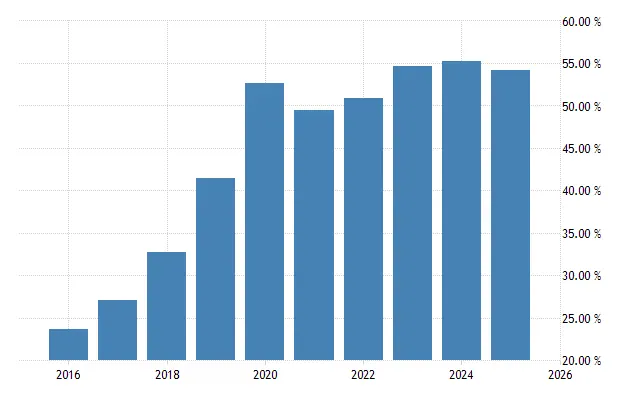
Liberia's debt is comprised of both external and domestic obligations, with multilateral institutions such as the World Bank and IMF among its major external creditors. A joint World Bank-IMF Debt Sustainability Analysis of Liberia's public debt indicates that by December 2023, Liberia's public debt had increased to US$2.539 billion, equivalent to 57.8 percent of GDP. However, this figure is not consistent with the Central Bank of Liberia's reported data.
The International Monetary Fund reported that Liberia's total public debt at the end of 2025 was US$2.863 billion, equivalent to 54.9% of GDP. Of this, external public debt was US$1.868 billion and domestic debt was US$996 million. These figures demonstrate the complexity of Liberia's debt situation and the need for accurate reporting.
To verify Ali's claim, the Local Voices Media Network reached out to him for the source of his information. He forwarded the ARREST Agenda's Implementation Summary, compiled by the Ministry of Finance and Development Planning. However, a review of this document and confirmation of the data cited by Ali did not align with the findings of the Central Bank of Liberia and the International Monetary Fund.
In conclusion, based on the data from the Central Bank of Liberia and the International Monetary Fund, Mo Ali's claim that the Unity Party government reduced Liberia's public debt-to-GDP ratio by 8.2 percentage points is incorrect. The country's debt-to-GDP ratio declined by only 0.7 percentage points from 51% at the end of 2023 to 50.3% at the end of March 2026.
Key points
- Mo Ali's claim of an 8.2% reduction in Liberia's debt-to-GDP ratio under the UP administration was incorrect.
- Liberia's debt-to-GDP ratio actually declined by 0.7 percentage points from 51% in 2023 to 50.3% in March 2026.
- The country's nominal public debt increased by approximately US$630 million over the period.