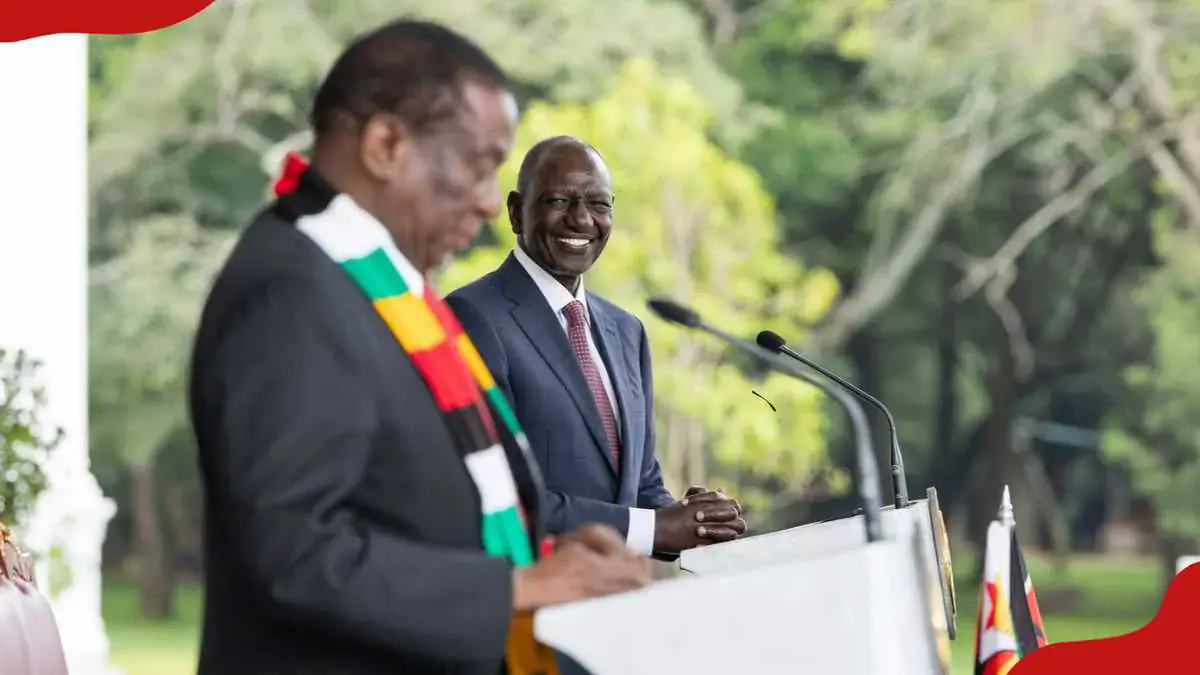
Zimbabwe President Emmerson Mnangagwa addressed concerns over his nation's currency stability during a joint press briefing at State House in Nairobi on November 27. A Kenya Broadcasting Corporation journalist, Austin Miramba, asked about the stability of Zimbabwe's currency and high inflation. Mnangagwa sharply rejected the question, stating that Miramba's understanding was based on outdated information. He urged the journalist to ignore contrary sources and highlighted that Zimbabwe's gold-backed Zimbabwe Gold (ZiG) currency, introduced in April 2024, had seen single-digit inflation since January 2026.
Mnangagwa and Miramba engaged in a tense exchange during the briefing. The journalist referenced Kenya's own recent shilling fluctuations and asked what lessons Kenyans could draw from Zimbabwe's experience. He also inquired about how Mnangagwa was addressing his country's economic difficulties. Mnangagwa acknowledged past economic challenges but claimed they had been resolved. The exchange was a notable moment in the briefing, which followed the co-chairing of the inaugural Zimbabwe-Kenya Bi-National Commission.
The briefing resulted in an unexpected invitation from Mnangagwa to Miramba. The Zimbabwean president offered to personally fund Miramba's trip to Zimbabwe, guaranteeing unrestricted movement and no security escort. This offer was seen as an attempt to showcase Zimbabwe's economic progress. President William Ruto of Kenya stepped in to back the journalist, describing Miramba as merely curious.
Kenya pledged logistical support for Miramba's proposed visit to Zimbabwe. The episode was linked to a media cooperation agreement signed earlier that day. The agreement aimed to enhance collaboration between the media outlets of the two countries. Mnangagwa's invitation and Kenya's support highlighted the strong ties between Zimbabwe and Kenya.
The joint press briefing was part of a larger effort to strengthen bilateral relations between Zimbabwe and Kenya. The two leaders signed seven memoranda of understanding covering immigration, trade, customs, media, and other sectors. This brought the total number of bilateral instruments between the two countries to 24. The agreements reflected the growing cooperation between Zimbabwe and Kenya.
Trade between Zimbabwe and Kenya has seen significant growth in recent years. Kenya-Zimbabwe exchanges climbed from KSh 4.6 billion in 2024 to KSh 7.5 billion in 2025. This increase was a positive sign for the economic relationship between the two nations. The growth in trade was likely a topic of discussion during the Zimbabwe-Kenya Bi-National Commission.
The meeting between Mnangagwa and Ruto demonstrated the importance of Zimbabwe-Kenya relations. The two leaders co-chaired the inaugural Zimbabwe-Kenya Bi-National Commission, marking a significant milestone in their bilateral cooperation. The commission provided a platform for the leaders to discuss key issues and sign agreements.
Key points
- Mnangagwa defended Zimbabwe's currency stability, citing single-digit inflation since January 2026.