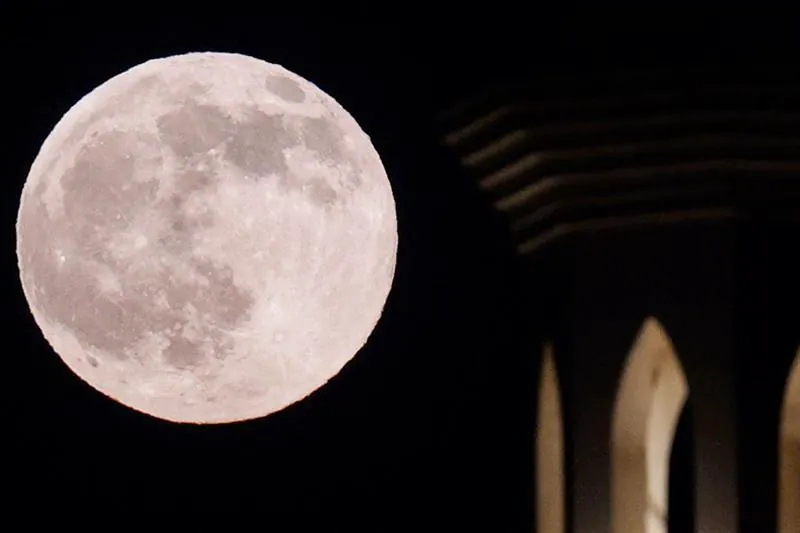
The full Moon reached its peak on Saturday, 26 September, and is known as the Harvest Moon, according to NASA, as it is the full Moon closest to the September equinox. This year's September full Moon is particularly notable as it rises in the east shortly after sunset, offering a striking sight for observers. The Harvest Moon is a significant event, especially in the Northern Hemisphere, where it is traditionally associated with the autumnal equinox.
For those in Cairo, the Moon rises at about 7:02 p.m. on Sunday and around 7:36 p.m. on Monday, according to Timeanddate. The Moon can be observed with the naked eye, while binoculars or small telescopes can provide a closer view of its surface. Observers are advised to look towards the eastern horizon shortly after moonrise, weather permitting, for the best view. This allows for a clear sight of the Moon's surface features.
The Harvest Moon is closely associated with the autumnal equinox, which marked the beginning of autumn in Egypt on Wednesday, 23 September, according to the Egyptian Meteorological Authority (EMA). The relatively short interval between moonrises around the equinox gives the Harvest Moon its distinctive seasonal significance. The Moon appears above the eastern horizon relatively soon after sunset on successive evenings, providing several nights of bright moonlight.
The full Moon closest to the autumnal equinox in the Northern Hemisphere is traditionally known as the “Harvest Moon.” In 2026, the 26 September full Moon is the Harvest Moon because it occurs closest to the September equinox. The Harvest Moon's name is linked to the additional evening light it historically provided during the harvest season, allowing farmers to continue working after sunset.
The September full Moon is also traditionally associated with the corn harvest and is known by names such as the “Corn Moon” among some Indigenous peoples of North America. The Harvest Moon is particularly associated with this effect because the Moon rises at nearly the same time on successive evenings around the autumnal equinox. This provides several nights of bright moonlight after sunset.
Three full Moons remain in 2026: the Hunter’s Moon on 26 October, the Beaver Moon on 24 November, and the Cold Moon on 24 December in Egypt. The November and December full Moons will also be supermoons, according to NASA. A supermoon occurs when a full Moon coincides with the Moon being near perigee, its closest point to Earth in its orbit.
The Harvest Moon offers a unique opportunity for skywatchers in Egypt and the Arab world to observe the Moon's beauty. With the Moon appearing full or nearly full for several evenings around the full Moon, observers can enjoy the sight on Sunday and Monday evenings. The Egyptian Meteorological Authority and NASA provide valuable information for those interested in observing the Harvest Moon and other celestial events.
Key points
- The Harvest Moon is the full Moon closest to the September equinox.
- The Moon can be observed with the naked eye or with binoculars and small telescopes.
- Three full Moons remain in 2026: the Hunter’s Moon, the Beaver Moon, and the Cold Moon.