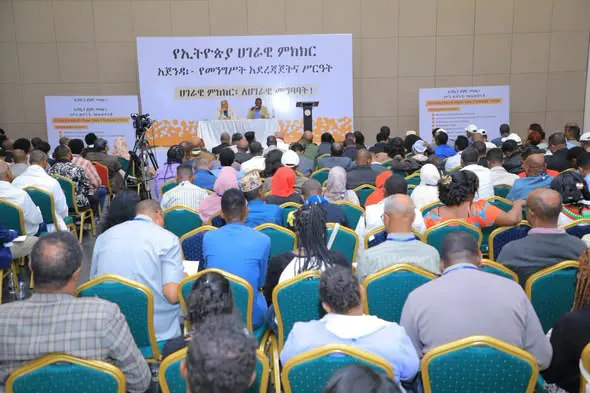
Ethiopia's National Dialogue Commission is currently working through eight thematic pillars to address the country's deep-seated issues. A recent memorandum submitted to the commission highlights the need for stronger safeguards against the politics of demographic dominance. The author argues that Ethiopia's deepest problem is not ethnic federalism itself, but the failure to make it work fairly. To address this, the commission must prioritize minority protection.
Ethiopia's history has been marked by mono-ethnic narratives, leaving little room for the histories and identities of other peoples. The expansion of the imperial state under Menelik II's conquests is still remembered by communities today, who experienced it as a form of political exclusion. Reconciliation efforts that overlook this history risk becoming another exercise in political convenience. A new national flag that can be claimed equally by all citizens, regardless of their ethnic or religious background, is one place to begin.
The design of federal institutions is also a critical issue. Smaller regions need a constitutional veto mechanism to prevent them from being overridden by a federal majority. The House of Federation should give states genuinely equal representation, rather than allowing demographic weight to determine political influence. This would prevent larger groups from dominating smaller ones and ensure that minority voices are heard.
Ethiopians living outside their ancestral regions also face significant challenges. In cities like Addis Ababa and Dire Dawa, people can face discrimination in housing, employment, public services, and political representation because of their ethnic identity. Meaningful representation of such communities in local government is therefore essential. A federation that protects people only when they are inside their designated ethnic homeland is not enough.
Religious grievances also need to be addressed. Seemingly ordinary administrative decisions can have a significant impact when public sanitation campaigns, examinations, or meetings are scheduled on major Islamic holidays. Restrictions affecting mosque construction and Muslim burial practices in Axum also raise questions about whether Muslims are treated as equal citizens. Addressing these grievances is not an attack on Christianity, but a matter of applying the constitutional principle that religion and state are separate.
The issue of property rights is also critical. Land and property confiscated during political transitions, particularly property belonging to Harari communities that was nationalized or redistributed without due process, cannot simply be treated as a closed chapter. Restitution is about recovering property, but also about the state acknowledging that an injustice occurred. Without that acknowledgement, calls for reconciliation can sound empty.
To ensure that minority protection is guaranteed, Ethiopia needs a permanent and independent minority protection institution to receive complaints, monitor violations, and advocate for constitutional rights. The National Dialogue Commission has an opportunity to address a weakness at the heart of Ethiopia's federal experiment and ensure that the country's federal system works fairly for all groups.
Key points
- Ethiopia's National Dialogue Commission must prioritize minority protection to ensure the country's federal system works fairly for all groups.
- A new national flag and federal institutions that give smaller regions a voice are critical to addressing minority grievances.
- An independent minority protection institution is needed to receive complaints, monitor violations, and advocate for constitutional rights.