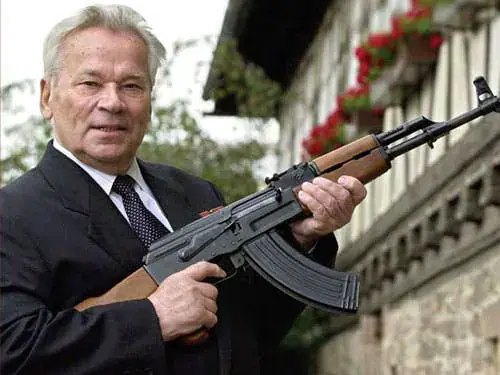
Mikhail Kalashnikov was born in 1919 in a simple farming family in the Soviet Union. During World War II, he joined the military and served as a tank commander. In 1941, he was wounded in a fierce battle against German forces. While recovering in a hospital, Kalashnikov heard his fellow soldiers complaining about the heavy and unreliable Russian weapons compared to the German arms. This sparked an idea in him to design a firearm that would protect his country.
Kalashnikov did not have a formal engineering education, but he had a natural talent for fixing and assembling machines. He experimented with various designs until 1947, when he completed his groundbreaking invention: the AK-47 rifle. The name "AK-47" stands for "Avtomat Kalashnikova," which translates to Kalashnikov's automatic rifle, model 1947. The rifle's simplicity, reliability, and durability made it an instant success.
The AK-47 went beyond being just a standard-issue rifle for the Russian military; it became the iconic firearm of liberation movements, national armies, and even militant groups worldwide. Some countries, such as Mozambique, even featured the Kalashnikov's image on their national flags. However, this widespread use led Kalashnikov to live with a sense of regret and disappointment. In several interviews before his death in 2013, he expressed his wish that he had invented a harvest machine instead of a rifle.
Kalashnikov's invention significantly impacted the course of modern history, transforming the face of warfare in the 20th and 21st centuries. Despite his mixed feelings about the AK-47's use, Kalashnikov remains one of the most influential military engineers in history. His legacy serves as a reminder of the profound effects that a single invention can have on global events.
The AK-47's impact extended beyond its military applications. It has been featured in numerous films, magazines, and news articles, becoming a cultural symbol of power and resistance. The rifle's widespread use has also led to concerns about its proliferation and misuse.
Kalashnikov's story serves as a fascinating example of how an individual's invention can take on a life of its own, often with unintended consequences. Despite his initial intention to protect his country, the AK-47 ultimately became a tool for various groups, some of which used it for violent and destructive purposes.
Today, Mikhail Kalashnikov's legacy continues to be felt, with the AK-47 remaining an enduring symbol of military might and technological innovation. As the world grapples with the complexities of conflict and violence, Kalashnikov's story serves as a reminder of the importance of responsible innovation and the need for careful consideration of the potential consequences of our creations.
Key points
- The AK-47 has become an iconic symbol of power and conflict worldwide, with over 100 million units produced since its invention in 1947.