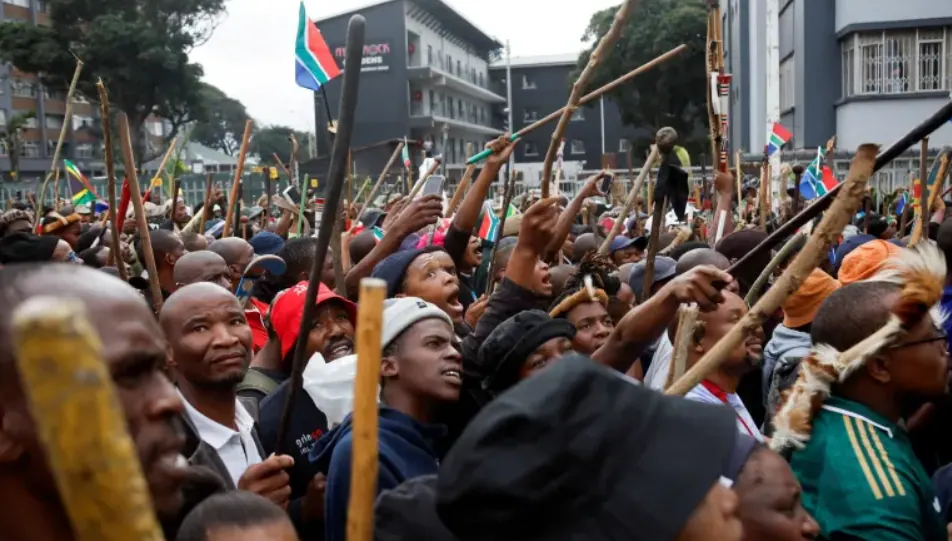
An impending September 30 deadline issued by the anti-immigration movement, March and March, has sparked anxiety across migrant communities in South Africa. The group has led protests throughout the year, demanding that undocumented foreign nationals leave the country. Organizers have warned of further demonstrations if their demands remain unmet. This has created a climate of fear among refugees and asylum seekers, who are already vulnerable.
For many refugees, official paperwork provides little protection from the hostility they face on the streets. Despite having the necessary documentation, foreign nationals are often caught in a climate of escalating fear as the nation approaches local government elections. The situation is further complicated by the fact that the hostility rarely begins with a request for identification documents. Instead, migrants are often targeted based on their nationality.
Hundreds of asylum seekers and refugees have been living on the pavement outside the Durban Refugee Reception Centre on Che Guevara Road. Fleeing violence in countries such as the Democratic Republic of the Congo, Burundi, Uganda, Mozambique, and Tanzania, they sought sanctuary near the Department of Home Affairs. However, the street became their home, and they had to rely on volunteers and civil society organizations for basic necessities.
The conditions at the encampment were dire, with migrants reporting irregular access to food and necessary medication. A man suffering from tuberculosis died at the encampment, highlighting the desperate struggle for survival that many faced. The camp offered no immunity from the hostility its residents hoped to escape, and on September 3, members of March and March confronted the refugees, leading to violence and police intervention.
March and March frames its mobilization as a campaign against crime, deteriorating community conditions, and insufficient government enforcement of immigration laws. However, refugees report that documented status offers no protection, and they are often targeted regardless of their documentation. Earlier this year, six refugee salon workers near Warwick Street Market were beaten with sticks, sending two to the hospital.
In mid-September, authorities cleared the makeshift Durban camp, presenting residents with stark choices. They could return to neighborhoods they previously fled or accept temporary placement at the Lindela facility in Gauteng. Located hundreds of kilometres away, Lindela is a government-run immigration detention center historically utilized for repatriation. Some feared detention, while others felt they could no longer endure life on the pavement.
On September 15, authorities transported 274 individuals by bus to Lindela, while roughly 150 others remained in Durban to seek alternative accommodation. The relocation has brought some respite, but the situation remains uncertain, and migrants continue to live in fear of further attacks and protests. The September 30 deadline has added to their anxiety, and many are unsure of what the future holds.
Key points
- The anti-immigration movement, March and March, has threatened further protests if their demands for undocumented foreign nationals to leave the country are not met by September 30.
- Migrants in South Africa, including refugees and asylum seekers, are living in fear of further attacks and protests, despite having official documentation.
- The situation has been exacerbated by the clearing of the makeshift Durban camp, which has left many without a safe place to live.