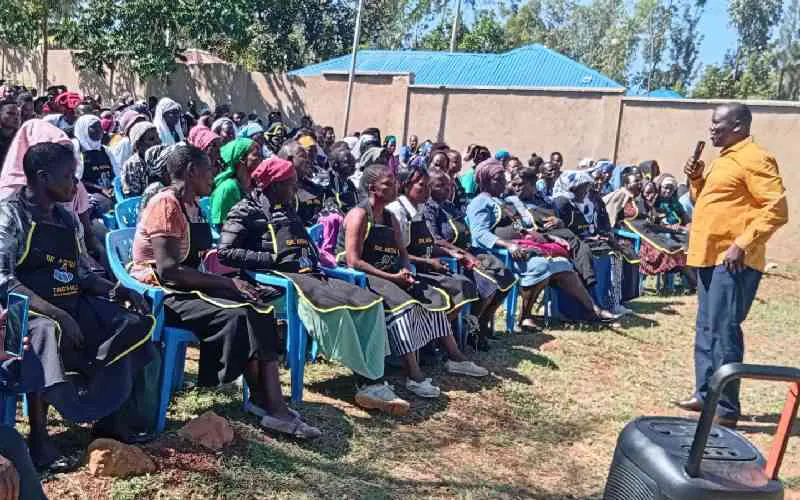
A recent training session in Karachuonyo Constituency, Kenya, brought together over 600 small-scale women traders to address the challenges they face in running their businesses. The training, organized by Kenyatta University lecturer Dr. Ramadhan Abdul, aimed to empower women to improve their livelihoods through business. During the session, it was revealed that financial responsibilities are a significant obstacle to the survival of businesses in the area.
Many women traders complained that their husbands abandon financial responsibilities when they start engaging in businesses, leading to the collapse of their ventures. Eunice Omuga, a trader from Kendu Bay, stated that women in business are burdened with buying everything in the house, including household items, which depletes their profit and capital. This situation forces many women to rely on shylocks, who often charge high-interest rates.
Dr. Abdul urged men to share household financial responsibilities with their wives and avoid placing the burden entirely on them. He emphasized that this would cushion women from expenditure that may kill their businesses. Dr. Abdul also advised women to avoid overloading their businesses with unnecessary expenditure, such as buying clothes or household items simply because others have done so.
The lecturer, who is vying for the Karachuonyo parliamentary seat, distributed Sh1,000 to each of the small-scale traders to boost their stock and reduce their reliance on shylocks. He stated that these traders often borrow small amounts, such as Sh500, and refund them with interest, which can be detrimental to their businesses.
Dr. Abdul emphasized that business is a key driver of the economy and has employed many people, and it must be promoted by empowering women, who are the majority players. He provided the traders with knowledge as a corporate social responsibility to improve economic growth in Karachuonyo.
The training session equipped women traders with essential skills, including record-keeping and the ability to differentiate between capital and profit. Beatrice Ojwang, a trader, stated that the knowledge acquired will help her tackle challenges in running her business. Amina Atieno, another trader, said that the knowledge on record-keeping will improve her capacity in business.
The initiative aims to promote economic growth and empower women traders in Karachuonyo Constituency. By sharing household financial responsibilities and acquiring essential business skills, women traders can improve their livelihoods and contribute to the local economy. Key points from the training include the importance of record-keeping, differentiating between capital and profit, and avoiding unnecessary expenditure.
Key points
- Dr. Ramadhan Abdul urges men to share household financial responsibilities with their wives who run small-scale businesses.
- Women traders in Karachuonyo Constituency receive Sh1,000 to boost their stock and reduce reliance on shylocks.
- The training session aims to empower women traders with essential business skills to improve their livelihoods and contribute to economic growth.