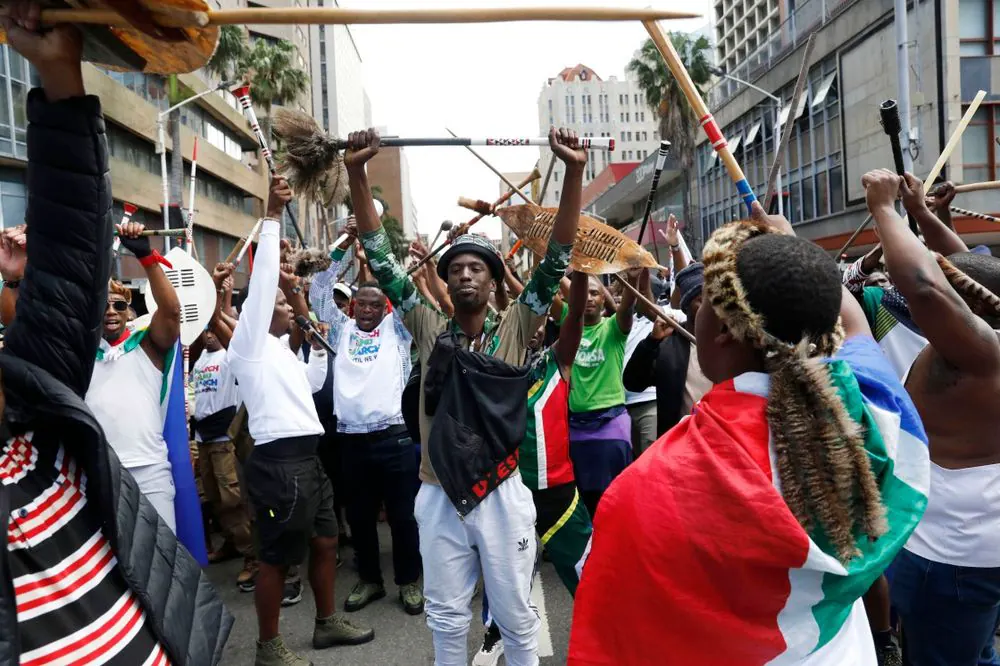
A march was held in Durban, South Africa, with hundreds of men participating, calling for urgent government action to address the growing concern of gender-based violence and femicide (GBVF). The demonstration also highlighted other pressing issues, including stricter border controls, reserving the township informal economy for South Africans, reforming the Road Accident Fund Act, and increasing security in high-risk areas. Various political parties, such as ActionSA, MK Party, and the IFP, were in attendance.
The march was led by March and March leader Jacinta Ngobese-Zuma, who emphasized the need for practical government action to end GBVF. The event comes after a recent surge in GBVF cases, particularly in Gauteng, where 11 women's bodies were discovered in Ekurhuleni since July. President Cyril Ramaphosa recently addressed the issue, announcing four immediate measures to tackle GBVF, including a national case-recovery audit, a funded 60-day plan to clear forensic backlogs, municipal safety audits, and a coordinated legislative package to reduce alcohol-related violence.
SA First Forum acting chief executive officer Xolani Zuma stated that the march was a call to action for the government to provide immediate solutions to the problem of GBVF. He emphasized that the issue is not only a men's problem but a societal issue that requires a collective effort to resolve. Zuma also mentioned that they are ending negotiations with the government and will launch a legal fight to force the government to amend laws, specifically demanding strict limits on refugee numbers and the removal of all illegal immigrants within two years.
ActionSA KZN leader and mayoral candidate Zwakele Mncwango expressed his support for the march, stating that it aligns with their call to say, 'Enough is Enough.' He emphasized that men must take a stand against GBVF and that it is a call to action for all men to unite against the perpetrators of violence. Mncwango also mentioned that men are raised to respect women and children, not treat them as punching bags, and that no justification or reason can ever excuse killing women.
The march and subsequent discussions highlight the growing concern over GBVF in South Africa. According to Zuma, the problems persist, and the government has not provided adequate solutions. He expressed skepticism over President Ramaphosa's four-point plan, stating that it may not be enough to solve the problem. The issue has sparked a national conversation, with various stakeholders calling for immediate and practical action to address GBVF.
The 16 Days of Activism against GBVF is an annual event, but Zuma emphasized that it should not be just an event, but rather a call to action for practical programs to deal with the killing of women and children in South Africa. He also mentioned that men must lead the charge against GBVF, as it is a societal issue that requires a collective effort to resolve. The march and subsequent discussions demonstrate the growing urgency to address GBVF in South Africa.
The issue of GBVF remains a pressing concern in South Africa, with various stakeholders calling for immediate action. The march in Durban and the subsequent discussions highlight the need for a collective effort to address the problem. Key stakeholders, including government officials, political parties, and civil society organizations, must work together to provide practical solutions to the problem of GBVF.
Key points
- The march in Durban was a call to action for the government to provide immediate solutions to the problem of GBVF.
- President Cyril Ramaphosa has announced four immediate measures to tackle GBVF, including a national case-recovery audit and a funded 60-day plan to clear forensic backlogs.
- The issue of GBVF remains a pressing concern in South Africa, with various stakeholders calling for immediate and practical action to address the problem.