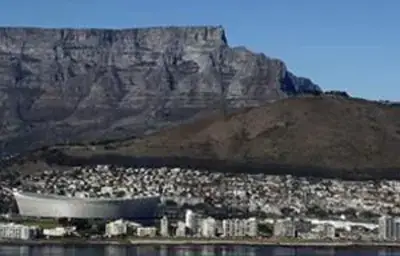
Cape Town is facing unprecedented pressure to densify due to its rapidly growing population, which is boxed in by mountains, sea, and the Koeberg nuclear evacuation zone to the north. As a result, every piece of state-owned land is being considered for development, including proposals to build on green spaces that were previously unthinkable. Two such proposals have been put forward: the Province's plan for 1,300 units on the Oude Molen Eco-Village and the City's plan for 6,000 units on King David Mowbray Golf Course and Clyde Pinelands Football grounds.
The concept of conserving corridors through the city, rather than just pockets of land, is crucial for allowing wild species to move freely across the city. Corridors make it easier for birds, animals, insects, and plant seeds to migrate, and pockets of conservation along a route become resting places. The Coast to Coast Greenway, a vision proposed by City landscape architect Hank Lith in 1982, aims to preserve an open-space network that follows the Black River and takes in several green spaces, including Rondebosch Common and the Mowbray golf clubs.
The importance of conserving corridors is highlighted by the unique plant species found on Rondebosch Common, which differ from those on the mountain. Preserving these areas is essential, and international practice favours a gradient of density around sensitive conservation areas, rather than hard development right up to the edge. In 1994, an environmental master's dissertation recommended retaining around 200 hectares of inner-city, low-density land use around the core conservation areas of the Raapenberg and Pallotti wetlands.
Despite earlier policy affirming the conservation of the Two Rivers Urban Park, a new generation of planners has marked it as a "New Development Area" in the 2023 Municipal Spatial Development Framework. The Oude Molen Eco-Village, a tranquil and beautiful place with a historic farmhouse, is now under threat from the Province's plan to build up to eight storeys high. The farm, given to the exiled Zulu King Cetshwayo, has significant historical value and is home to schoolchildren who tend vegetable gardens and tea rooms.
The King David Mowbray Golf Course, the second oldest in Cape Town, is also under threat from the City's plan to turn it into a new suburb of housing and shops. The golf course has significance to the Jewish community and is being re-wilded in areas from Kenilworth Racecourse. Alternative areas for housing development have been suggested, including the City's old abattoir site, derelict state land, and the abandoned Telkom head office.
The proposed suburbs are not near the preferred major bus or BRT routes, and their rail line serves little but the city centre, where only around a fifth of Capetonians work. Better transport links from the Metro South-East to the West would integrate the city and ease pressure on the network radiating from the centre. Multiple converging reasons argue for preserving the Black and Liesbeek river confluence from wall-to-wall development.
Densification is necessary, but it should not come at the cost of green spaces next to rivers, well-used sports amenities, and land of heritage significance. The Oude Molen Eco-Village and King David Mowbray Golf Course should be conserved as part of the Coast to Coast Greenway. By preserving these areas, Cape Town can maintain its ecological balance and provide a high quality of life for its residents.
Key points
- The Province's plan for 1,300 units on the Oude Molen Eco-Village and the City's plan for 6,000 units on King David Mowbray Golf Course and Clyde Pinelands Football grounds have sparked concerns over conservation of Cape Town's green spaces.
- Conserving corridors through the city, rather than just pockets of land, is crucial for allowing wild species to move freely across the city.
- Alternative areas for housing development have been suggested, including the City's old abattoir site, derelict state land, and the abandoned Telkom head office.