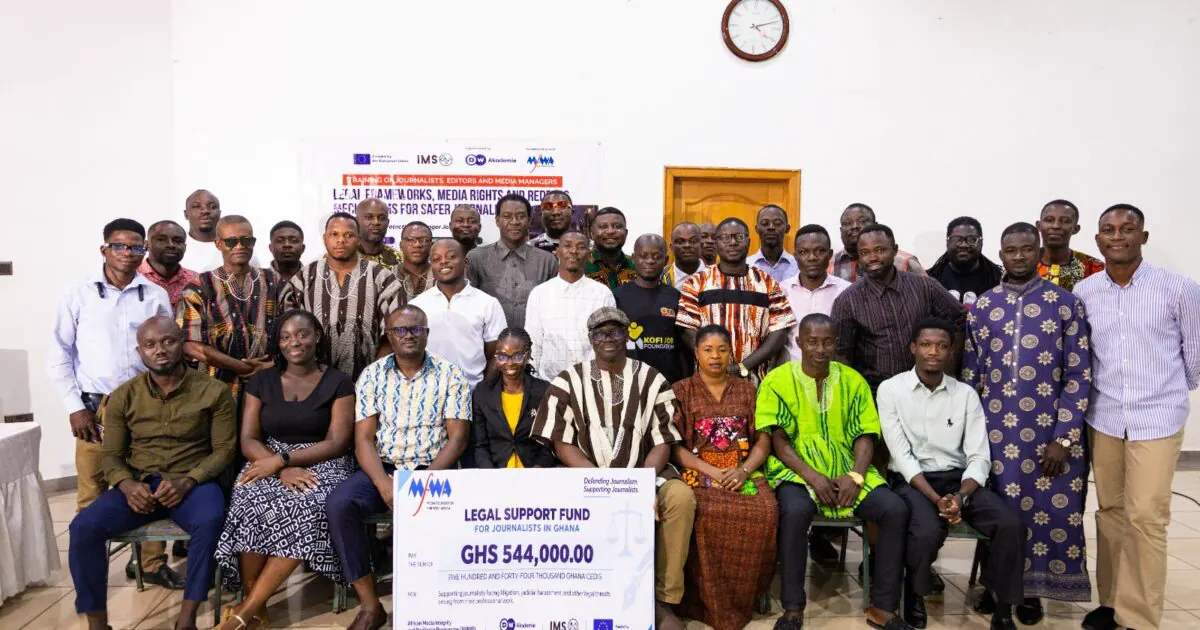
The Media Foundation for West Africa (MFWA) has introduced a GH¢544,000 Legal Support Fund (LSF) to mitigate the challenges faced by Ghanaian journalists in pursuing investigative stories. The fund, launched in Accra in September 2026, aims to provide legal support to journalists and media organisations facing litigation, judicial harassment, and other legal threats arising from legitimate professional work. This initiative is part of the African Media Integrity and Resilience Programme (AMIRP), implemented in Ghana by MFWA in partnership with DW Akademie through International Media Support (IMS), with funding from the European Union.
The launch of the LSF is a significant development in Ghana's media landscape, as it seeks to address the growing concern of journalists being held back from pursuing important stories due to fear of legal repercussions. According to Clinton Yeboah, the fund will ensure that journalists can continue to hold public officials and institutions accountable without fear of retribution. The MFWA's initiative has been welcomed by journalists and media organisations, who see it as a crucial step towards protecting press freedom and promoting good governance in Ghana.
The LSF is not just about providing financial support to journalists; it also aims to enhance their knowledge of media law and legal-risk management. Recently, the MFWA conducted an intensive training programme on media law and legal-risk management, which was attended by sixty journalists from across the country. The training, facilitated by renowned private legal practitioner and broadcaster Samson Lardi Anyenini, equipped participants with the skills to identify potential defamatory claims, privacy concerns, and other legal vulnerabilities before publishing a story.
The training programme was a timely intervention, as Ghanaian journalists often face significant challenges in navigating the country's complex media laws. The 1992 Constitution guarantees the right to information, subject to certain qualifications and laws necessary in a democratic society. However, repressive laws such as Section 208 of the Criminal Code of 1960 (Act 29) and Section 76 of the Electronic Communications Act (2008) have been used to harass and intimidate journalists. The MFWA's LSF is expected to provide a safety net for journalists who are committed to upholding the principles of press freedom and accountability.
Ghana has a reputation for being one of Africa's more stable democracies, with a constitutional framework that protects the media from governmental control and interference. However, the practical cost of defending these freedoms can be prohibitively expensive for journalists and media organisations. The MFWA reported 14 arrests linked to "false news" and offensive speech laws within the first 16 months of President John Mahama's administration, compared to eight arrests during the entire eight-year governance of former President Nana Akufo-Addo.
The LSF has been designed to support journalists who have acted responsibly, ethically, and in the public interest. To be eligible for support, journalists must demonstrate that they have taken reasonable steps to verify the accuracy of their stories and have not acted recklessly or with malice. The fund will provide financial assistance to cover the costs of legal representation, court fees, and other expenses associated with defending against litigation and harassment.
The introduction of the LSF has been hailed as a significant step towards promoting press freedom and accountability in Ghana. By providing legal support to journalists, the MFWA aims to create an environment where journalists can pursue investigative stories without fear of retribution or financial hardship. The fund is expected to have a positive impact on the quality of journalism in Ghana, enabling journalists to hold public officials and institutions accountable for their actions.
Key points
- The Media Foundation for West Africa has launched a GH¢544,000 Legal Support Fund to provide legal assistance to journalists facing litigation and harassment.
- The fund aims to promote press freedom and accountability in Ghana by supporting journalists who have acted responsibly and in the public interest.
- The initiative is part of the African Media Integrity and Resilience Programme, implemented in Ghana by MFWA in partnership with DW Akademie through International Media Support, with funding from the European Union.